
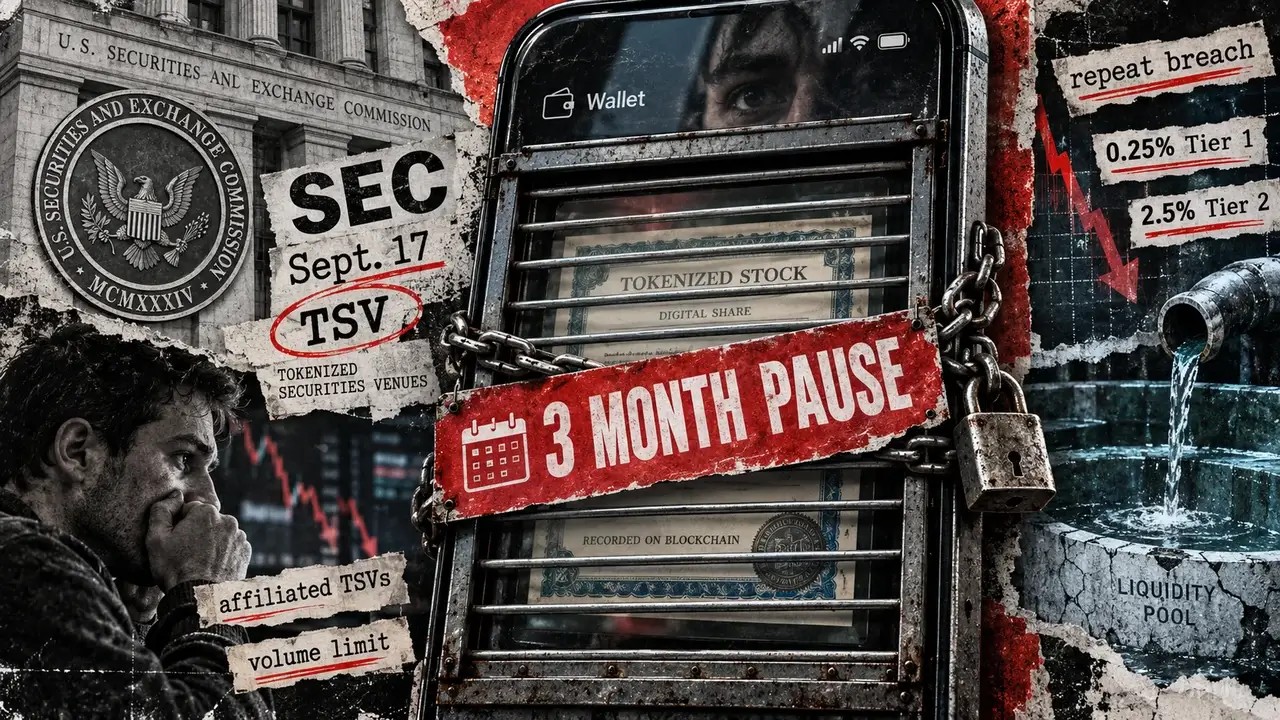
Buying a tokenised stock may look much like ordinary share investing: choose a company, purchase a digital token linked to it and keep it in a wallet. But under a new US Securities and Exchange Commission (SEC) experiment, repeated breaches of trading limits could force a particular tokenised stock to stop trading for three months.
The rule is part of the SEC’s 17 September framework for experimental Tokenized Securities Venues (TSVs). It applies to the affected stock across the relevant exchange and its affiliates, rather than automatically stopping every token representing that company’s shares elsewhere.
That distinction matters because owning a token, holding the rights attached to a share and having a reliable market in which to sell it are separate issues, even if an app presents them as one product.
What does a token represent?
Traditional shares are already held electronically through brokers and financial institutions. Tokenisation adds blockchain records to the way ownership, or a claim linked to ownership, is recorded and transferred.
The SEC’s January explanation identifies different models. A company or its agent may use blockchain as part of its ownership system, while another arrangement involves a third party holding shares and issuing tokens representing an interest in them. A token may also provide synthetic exposure to a stock’s performance without granting ownership or shareholder rights.
CryptoSlate has reported on stock tokens whose buyers are not shareholders. Investors therefore need to establish who is responsible for the token and what rights it provides. If a separate issuer stands behind it, that firm’s financial position and obligations become an additional investment risk.
Under the SEC experiment, eligible tokenised stocks must retain the economic and governance rights of their traditional equivalents, including dividends and voting rights. Synthetic products do not qualify. Access is permissioned, so participants or their wallets must satisfy verification requirements.
The five-year trial permits trading through automated market makers. Instead of matching buyers and sellers directly, software allows trades against pools of assets supplied by participants. In a basic pool containing stock tokens and a payment asset, buying the stock removes tokens and adds payment assets, with a formula adjusting the price as the pool’s holdings change. Uniswap describes this general liquidity-pool model, although exchanges may use different systems.
When does the three-month pause begin?
The SEC limits both the number of eligible stocks and the amount that can be traded. Tier 1 covers S&P 500 and Russell 1000 stocks and certain exchange-traded products, with a maximum of 75 symbols across affiliated exchanges. Their average daily tokenised volume cannot exceed 0.25% of the traditional stock’s previous-month average daily share volume.
Tier 2 covers other eligible securities, allowing up to 250 symbols and a threshold of 2.5%. Activity on affiliated exchanges is combined, and the test uses average volume rather than a single busy trading session.
For example, if a traditional stock averaged 10 million shares a day during the previous month, the Tier 1 threshold would be 25,000 shares in average daily tokenised trading.
The first breach receives a grace allowance, with the exchange required to ensure future compliance. Each subsequent breach triggers an immediate three-month suspension for that stock, including at affiliated TSVs. The period begins on the breach date, while other stocks may continue trading. Exchanges can suspend trading earlier, must notify participants immediately and must update their public notice within five business days.
The SEC says the limits are intended to protect the wider market while it assesses risks, including cases where liquidity-pool prices diverge from traditional share prices. Limited inventory and heavy buying could push a token’s price higher than the broader market valuation, although traders might bring prices back together if they have sufficient capital and access to both markets.
For buyers, the central issue is what happens when they need to sell. Transferring a token to another wallet does not necessarily provide a solution: an eligible market for that exact instrument or a redemption route must exist.
The three-month rule is not a guarantee that another broker will accept the token, nor a universal ban on every transfer. Those questions depend on the product, its supporting institutions and the permissions attached to it.
Longer trading hours also do not guarantee an effective exit. As SEC Commissioner Mark Uyeda said at the agency’s 24-hour trading roundtable, extra hours could distribute liquidity more evenly or spread it too thinly.
Before investing, buyers should seek a clear example of what happens if the exchange stops trading the token, including its custody arrangements, shareholder rights, transfer permissions, redemption options and costs. A token in a wallet shows ownership of only part of the investment picture; a dependable route to sale is equally important.


