
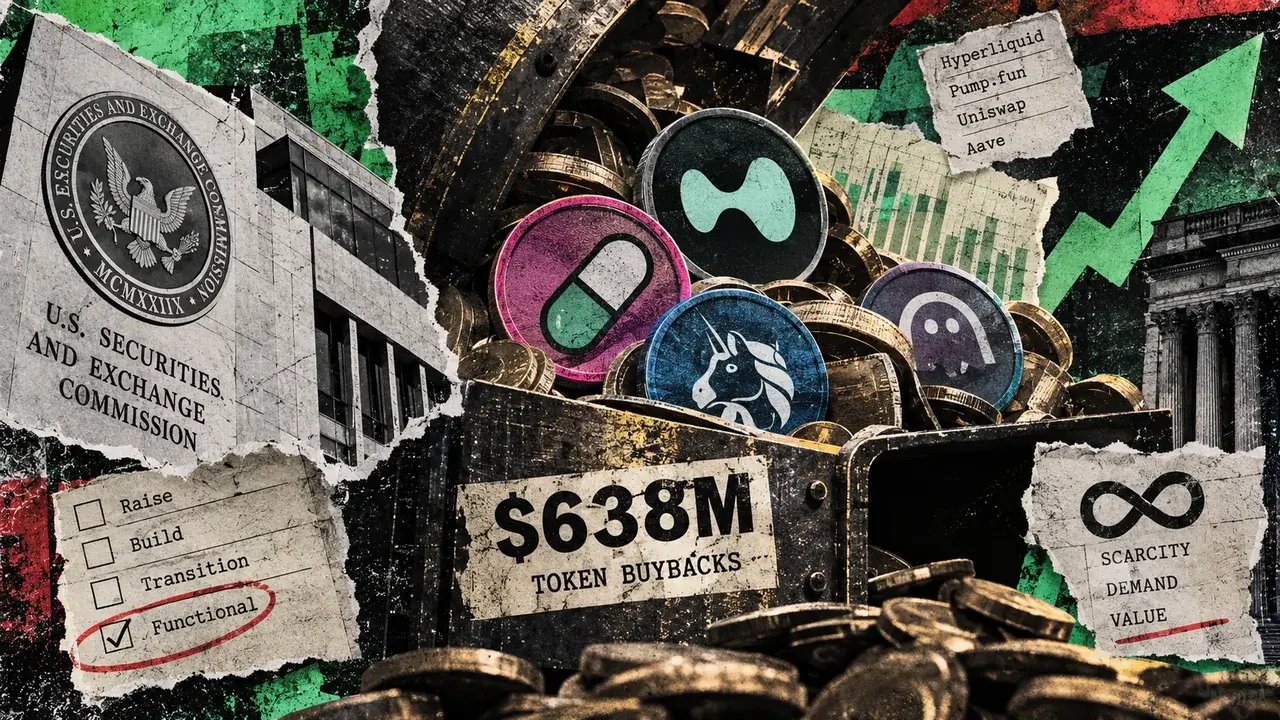
Crypto projects spent a record $638m buying back their own tokens in the first eight months of 2026, according to data from Allium Labs.
The figure, recorded through late August, is up from $545m over the same period in 2025. Hyperliquid accounted for about $370m and Pump.fun approximately $200m, meaning the two projects were responsible for almost 90% of the total.
The Securities and Exchange Commission (SEC) addressed the legal uncertainty surrounding such programmes on 25 September. Its Division of Corporation Finance said an issuer announcing a buyback for a non-security crypto asset on a functional network would not, by itself, amount to a promise of the “essential managerial efforts” central to the Howey test for investment contracts.
However, the guidance applies only where the network is already functional and the token is outside securities law. For younger projects, promoting buybacks as a source of yield or returns before the network is operational could contribute to an investment-contract analysis.
The SEC said its staff guidance has no legal force. Under the agency’s March interpretation, a network is functional when its native token can be used for its programmed utility.
From fundraising to buybacks
The March interpretation says a token may initially be sold as part of an investment contract while a team raises money by promising managerial work. That contract may end when buyers no longer expect profits from those efforts.
Under the proposed Regulation Crypto Assets rules, projects could raise up to $5m over four years through a start-up exemption. A separate exemption would permit fundraising of up to $75m every 12 months, with disclosure obligations attached to both routes.
Proposed Rule 400 would introduce Form TR, through which an issuer files on EDGAR to confirm that its promised managerial efforts have been completed or permanently stopped. The SEC could later challenge whether the conditions had been met. The agency estimates about 475 issuers a year could use the safe harbour, based on 15% of the roughly 3,165 projects launched in 2024. The consultation closes on 20 October.
The proposed framework would create a route from securities-regulated fundraising to a mature network able to use revenue for token purchases. Form TR would cover projects that completed their roadmaps and those that abandoned them, while the buyback FAQ applies only to functional networks.
Pump.fun says it allocates half its revenue to buying and permanently burning PUMP. Its dashboard reports about $500m in annualised revenue, $462.5m in cumulative purchases and 167.7bn tokens destroyed, equivalent to 16.8% of the original supply. At the current rate, annual purchases would be about $250m, or 6.4% of its displayed $3.91bn fully diluted valuation.
Hyperliquid has bought and burned about $1.3bn of HYPE since launch, with more than $1bn in annualised fees directed towards programme purchases. Uniswap introduced protocol fees on Ethereum mainnet in December 2025 and later expanded them to other chains; searchers obtain accumulated fees only by burning UNI.
But new issuance can offset burns. Hyperliquid funds staking rewards from future emissions, while a protocol burning 5% of supply but issuing 8% through emissions and unlocks still dilutes holders. Aave bought more than 205,000 AAVE, about 1.28% of supply, for roughly $42m in its first ten months, before its DAO paused purchases on 19 April after the rsETH bridge incident. Governance had debated reducing its annual budget from $50m to $30m as revenue weakened.
Crypto’s total remains small beside Wall Street: S&P 500 companies spent $1.02tn on buybacks in the 12 months to September 2025. Crypto buybacks rose from about $366,000 in 2024 to $638m in less than eight months of 2026.
The tokens generally provide no inherent right to protocol income or profits. Governance can change or suspend a programme, and future emissions may overwhelm burns. If Regulation Crypto Assets stalls or emerges in a weaker form, the non-binding FAQ is likely to remain the main source of comfort, with projects treating buybacks as discretionary.
At current run rates, Hyperliquid and Pump.fun alone indicate annual industry buybacks above $1bn. However, revenue-linked purchases would fall if income declined, while exploits or bad-debt events could force treasuries to conserve funds, as happened at Aave.


