
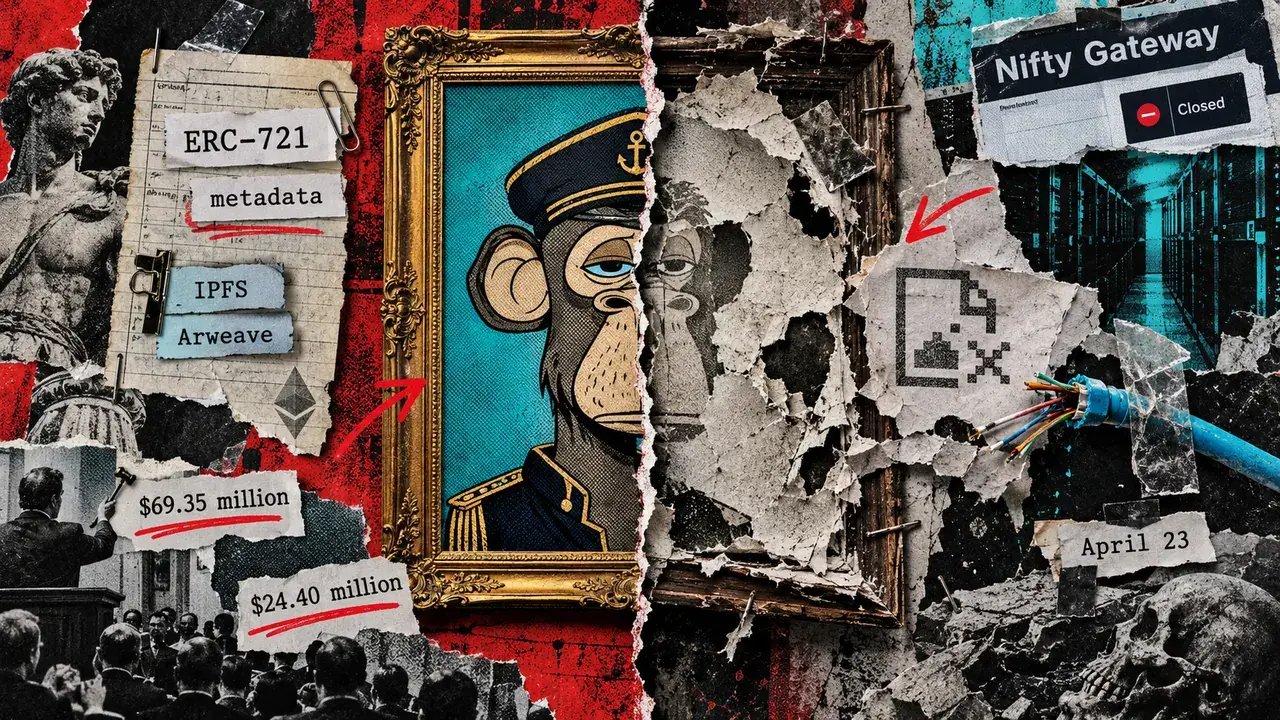
The NFT market’s spectacular rise has left collectors with an unexpected responsibility: paying to keep the artwork they bought available after the platforms that sold it begin to disappear.
In 2021, Christie’s sold a Beeple NFT for $69.35 million, while Sotheby’s raised $24.40 million for 101 Bored Ape Yacht Club NFTs. Cartoon primates were receiving the sort of auction-house treatment usually associated with Faberge eggs.
Less than five years later, Nifty Gateway the NFT marketplace owned by crypto exchange Gemini announced that it would close as its parent company focused on its main financial app. Its exit plans included a bulk withdrawal tool and arrangements for hosting customers’ artwork.
The closure exposed a weakness in the idea that buying a token guaranteed permanent ownership of the associated image or video. In reality, the token, the artwork and the website displaying it may all have different lifespans.
The token is not the artwork
Many Ethereum NFTs use the ERC-721 standard, which records ownership and enables transfers. That record is kept on the blockchain, but the token commonly points to a separate metadata file containing the work’s title and a link to its image or video.
A digital wallet retrieves those elements and displays them together, creating the impression of a single possession. Transferring the token to a wallet controlled by the buyer does not automatically download the artwork, transfer control of the hosting server or pay for its continued operation.
Nifty Gateway said it planned to move metadata and media hosting to Arweave, a network designed for long-term storage. However, some NFTs created in 2021 or earlier had metadata permanently linked to Nifty Gateway’s own servers. The company said it would host that metadata indefinitely and extended the withdrawal deadline to April 23.
Those arrangements did not establish that every migration had succeeded or that any particular work had been lost. They did, however, demonstrate the risk of permanently linking an NFT to a company-owned address: the artwork remains dependent on that business for as long as the link works.
Distributed storage can reduce that dependence. IPFS identifies content from the data itself, allowing multiple computers to provide verifiable copies. But joining the network does not require every computer to preserve a file. Cached material can be deleted, while “pinning” instructs a computer to retain specific content.
A collector can operate that computer or pay a storage provider, but somebody must continue accepting the cost and responsibility. A missing image may also reflect a failed IPFS gateway a website that retrieves the file rather than the disappearance of the data. If no one has retained a copy, however, another gateway cannot restore it.
Other approaches include storing artwork directly on the blockchain or using networks intended to finance long-term retention. Each has dependencies, including the survival of the blockchain and the incentives for storage providers to continue operating.
Preservation was never automatic
Museums were considering these problems while NFT auction records were being set. A December 2021 discussion published by LACMA saw digital preservation manager Joey Heinen and computer scientist Elian Carsenat examine the software, storage and continuing work required to keep NFT art accessible over 10 or 30 years.
MoMA’s 2016 account of restoring Teiji Furuhashi’s Lovers showed that older digital art can depend on obsolete technology such as MS-DOS and LaserDiscs. Preserving the installation meant restoring its projected images and interactive behaviour, not simply storing its original components.
The same applies to NFT works that rely on software or live services. A still image is relatively simple to retain; interactive art may require documentation and maintenance of the environment in which it runs.
The token never made its visible image impossible to copy. In some cases, preserving accurate copies may help the work survive. A duplicate does not transfer ownership of the token, but it may prove valuable if it becomes the only surviving version of the artwork.
Collectors therefore need to know where their files live, how they can be preserved and who will take responsibility when a platform or provider moves on. Owning digital art may begin with clicking “buy”, but keeping it available ultimately requires long-term custodianship.


