
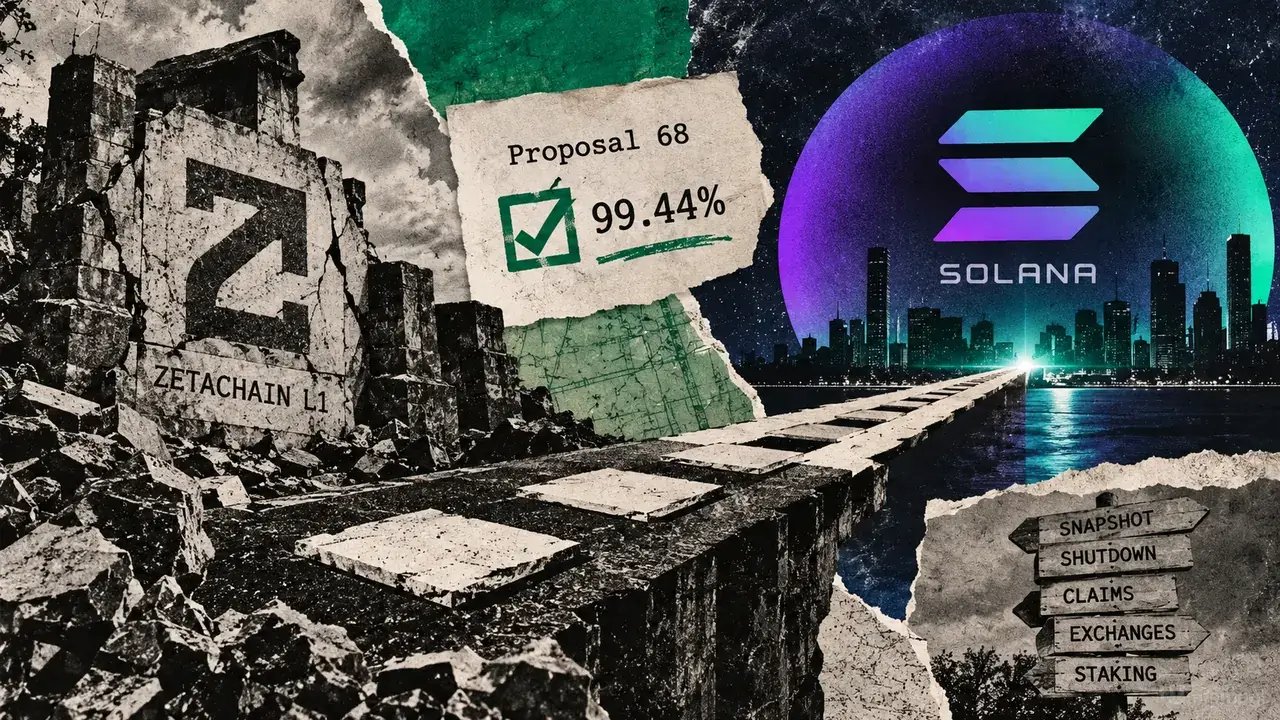
ZetaChain’s community has voted to retire the project’s standalone blockchain and move its ZETA token to Solana as it redirects its strategy towards private artificial intelligence.
Proposal 68 was approved when voting closed on 20 September, with about 99.44% of votes supporting the plan. The on-chain tally recorded 263.65 million ZETA in favour, 744,658 against and 752,300 abstentions.
The decision gives ZetaChain’s core contributors authority to prepare the migration, but it does not immediately transfer tokens or close the network.
ZetaChain was founded in 2021 to connect separate blockchain networks. It spent years developing a Cosmos SDK-based layer-1 through which applications could interact with assets and smart contracts on Bitcoin, Ethereum and Solana.
The project has since shifted resources towards Anuma, a private, multi-model AI application built around its Private Memory Layer. It now says running its own blockchain is no longer the best way to support that work.
In Proposal 68, ZetaChain said maintaining a Cosmos-based network involved coordinating security advisories and software patches across dozens of independent validators. The project expects that burden to grow as AI tools make it easier to identify vulnerabilities.
A move to Solana would remove the need to maintain that validator infrastructure and allow contributors to concentrate on Anuma and the wider AI application layer. ZetaChain said “every contributor hour” would instead be directed towards ZETA, Anuma and development on Solana.
The project says Anuma has gained more than 300,000 users since February and handled more than 1 million requests across 35 AI models. Each account also contains a wallet, potentially allowing those users to enter the Solana ecosystem alongside the token.
ZetaChain said Solana provides the speed, low fees, liquidity and developing agent-payment infrastructure required by AI applications that could make frequent payments or model requests. It cited transaction confirmations of about 400 milliseconds, more than $15 billion in stablecoins on the network and roughly $70 billion in monthly decentralised exchange volume.
Under the plan, ZetaChain’s native balances would convert on a 1:1 basis into a Solana-native SPL token using the existing ZETA ticker. The total supply would remain unchanged, with no new tokens created. Once the process is complete, the Solana token would become the canonical version of ZETA and the existing layer-1 would be wound down.
ZETA would be repositioned primarily as an access token for ZetaChain’s AI products, rather than as an asset used to secure an independent proof-of-stake network. Anuma already allows users to lock ZETA in return for credits used for AI services, taking those tokens out of circulation. ZetaChain wants other AI applications and agents on Solana to adopt the same model.
ZETA held on Ethereum and BNB Chain is not covered by Proposal 68, and existing vesting schedules will remain unchanged. Balances transferred from ZetaChain will move from 18 decimal places to Solana’s nine and be rounded down. The proposal does not say how fractional remainders will be handled.
The timetable will depend on centralised exchanges confirming how they will support the swap. A second governance proposal is expected to set the withdrawal period, snapshot and halt heights, the opening of Solana claims, exchange-held balance conversions, holder protections and the validator wind-down process.
Staking rewards will continue until the layer-1 closes, but its future after the move remains undecided. Until exchanges agree the arrangements and token holders approve them, ZetaChain will continue operating the network it has voted to retire.


