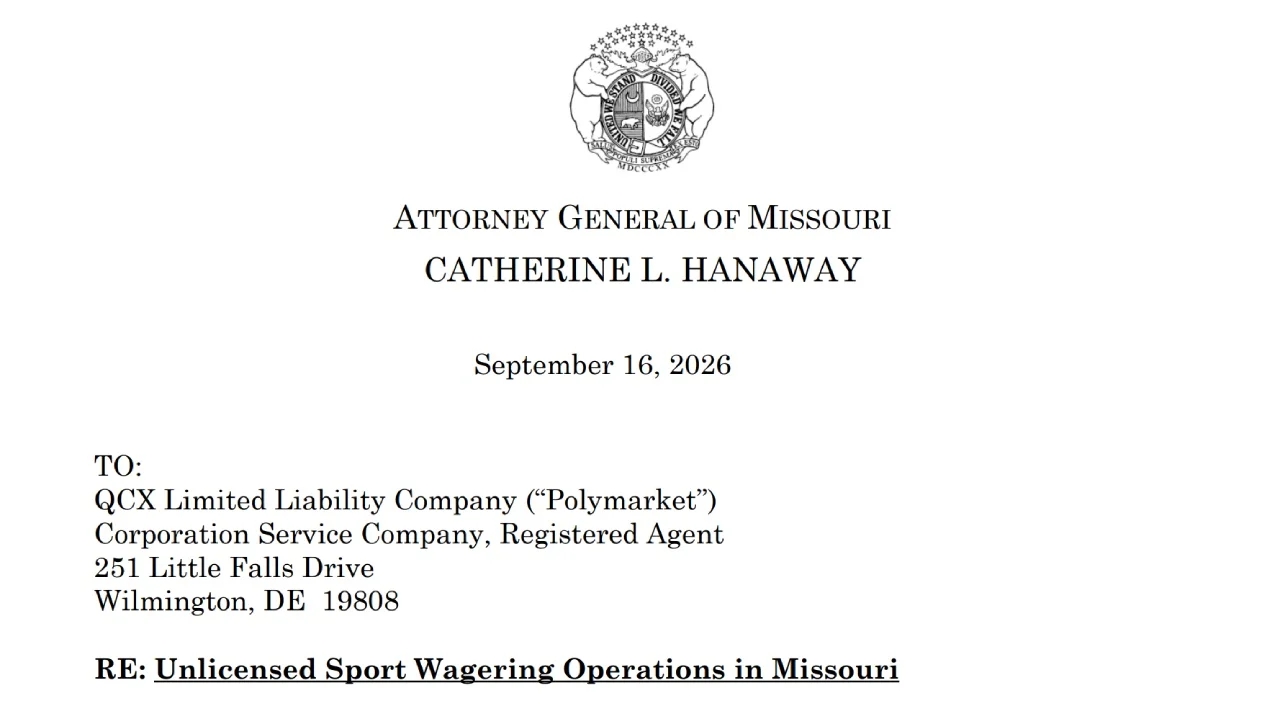
Missouri Attorney General Catherine Hanaway has issued cease-and-desist letters to Polymarket, Kalshi, Crypto.com, Novig, Underdog and Robinhood, ordering the companies to stop offering sports-related event contracts to residents or risk enforcement action.
Hanaway’s office says the products amount to unlicensed sports wagering under Missouri law. The state is challenging the platforms’ use of prediction markets to offer contracts based on sporting events.
The companies describe the products as “event contracts”, or “swaps”, and have argued that they fall under the Commodity Exchange Act (CEA). On that basis, the platforms claim they are subject to the exclusive oversight of the Commodity Futures Trading Commission (CFTC), rather than individual state gambling laws.
Missouri rejects that interpretation. In the letters, the attorney general’s office referred to several federal court rulings which it said had found that the bets did not meet the definition of “swaps” and were therefore outside the CFTC’s authority.
The state also argued that the platforms had caused economic harm by operating without paying the licensing fees or the 10% wagering tax applied to adjusted gross revenue from sports wagering in Missouri.
“Missourians voted for a safe, well-regulated sports wagering market that supports public education and addresses problem gambling. Companies cannot repackage sports bets as ‘event contracts’ to avoid Missouri law. We will enforce the rules voters approved and protect consumers,” said Hanaway.
The companies have 30 days to end the provision of sports-based event contracts in Missouri. Failure to do so could lead to enforcement proceedings.
The dispute is part of a wider conflict between US states and prediction market operators over whether sports event markets are gambling products governed by state law, or financial contracts regulated at federal level.
On September 2, New Jersey asked the Supreme Court to decide whether federal law prevents states from regulating sports bets placed within their borders when those bets are offered on markets registered with the CFTC.
States have continued to challenge the commission’s position, while the CFTC has maintained that it has exclusive jurisdiction over the contracts.
CFTC chairman Michael S. Selig said in April: “To any state that seeks to nullify federal law and seize authority over these markets, I say again: We will see you in court.”
New Jersey’s Supreme Court petition followed legal developments involving the Third and Ninth Circuits, which have been part of the broader dispute over the status and regulation of sports-related prediction market contracts.


