
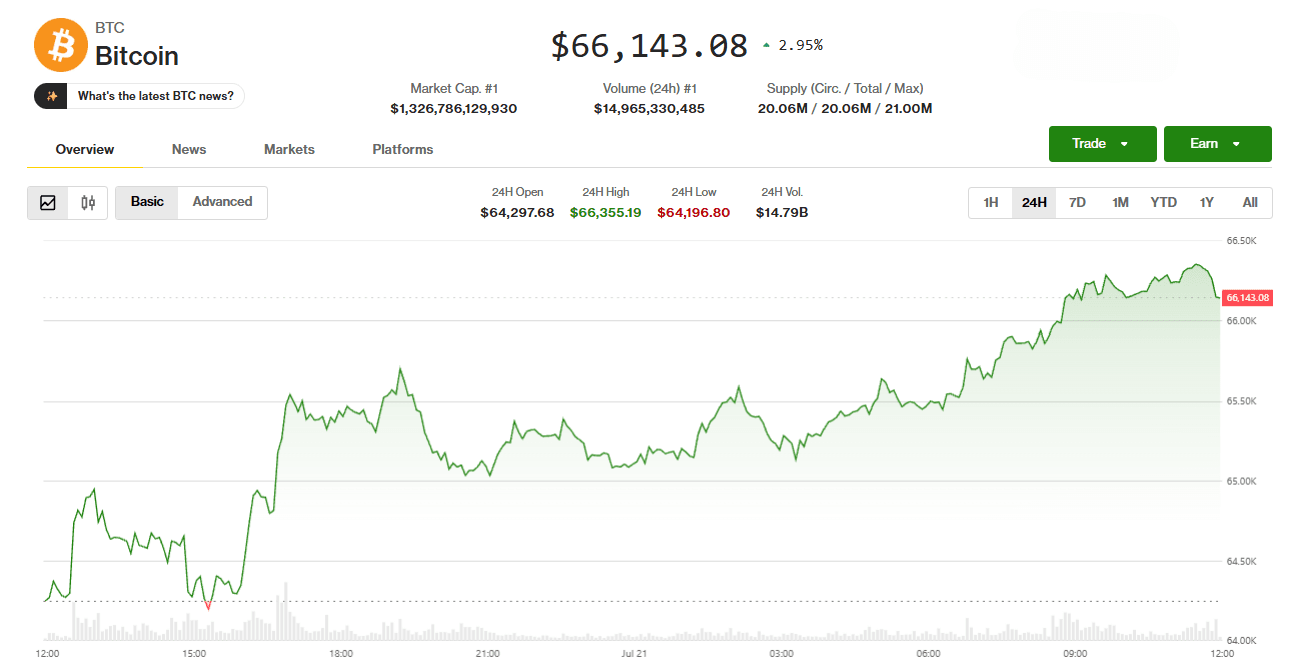
Crypto assets jumped sharply on Tuesday after reports that US President Donald Trump had accepted a key ethics provision tied to a major crypto market structure bill, paving the way for the so‐called Clarity Act to move through the Senate.
Bitcoin climbed back above $66,000, pulling a wide range of digital currencies higher, while Asian equity markets saw a rebound led by artificial intelligence‐linked semiconductor stocks.
Analysts said the combination of a clearer prospective regulatory framework in the US and renewed risk appetite in Asia had helped ignite the latest rally across both spot and derivatives markets.
Bitcoin breaks $66,000 as risk appetite returns
Bitcoin was last seen around $66,262, up just over 2%, as traders responded to signs of political progress in Washington on long‐discussed crypto legislation.
The rally extended beyond bitcoin, with major alternative cryptocurrencies – including large‐capitalisation tokens such as BNB – posting gains. BNB traded near $576, up about 1%, reflecting broader optimism across the market.
Derivatives data showed an accompanying build‐up in speculative activity. Open interest in both bitcoin and ether futures increased, and options flows were dominated by call purchases, typically a sign that traders are positioning for further upside.
At the same time, measures of implied volatility and so‐called “put skew” – the premium investors are willing to pay for downside protection – indicated that demand for hedging remained firm. That mix suggests participants are willing to chase the move higher while still insuring against sharp reversals.
Clarity Act hopes fuel institutional sentiment
The reported concession by President Trump centres on an ethics provision seen as crucial to getting the Clarity Act through the US Senate. The bill is designed to provide a clearer regulatory framework for digital assets, an issue that has long been cited by large investors as a barrier to deeper involvement in the sector.
Market participants view the latest development as a sign that political resistance to comprehensive crypto rules may be easing, at least in the near term. A more predictable rulebook could help unlock additional institutional capital and legitimise a broader range of crypto‐related products and services.
That backdrop has coincided with a marked recovery in on‐exchange activity. Centralised exchange (CEX) trading volumes rose in June for the first time in five months, with spot volumes jumping 15.3% to $1.11tn.
Real‐world asset (RWA) perpetual futures – derivatives tied to tokenised versions of traditional assets such as bonds, credit or commodities – hit a record $311bn in volume, underlining the growing appeal of tokenisation among professional investors.
Solana tokenisation boom signals structural shift
One of the key beneficiaries of the tokenisation trend has been the Solana blockchain. In the second quarter, tokenised asset volume on Solana reached an all‐time high, driven by rapid growth in real‐world asset issuance.
The surge in activity on Solana is seen by some as evidence of a structural shift, with more institutions experimenting with blockchain rails to issue, trade and manage conventional financial instruments in tokenised form.
The expansion of RWA products has been closely watched by regulators and traditional financial firms, who view the space as a potential bridge between familiar asset classes and newer crypto‐native infrastructure.
Asian AI chip rebound adds to risk rally
The positive mood in digital assets was mirrored in parts of the Asian equity market, where chipmakers and AI‐linked technology stocks staged a rebound after recent weakness.
The recovery in semiconductor shares, which are central to the current boom in artificial intelligence computing, helped lift broader indices and reinforced the global risk‐on tone.
Combined with the prospect of greater regulatory clarity in the US, the rebound in growth‐sensitive sectors has encouraged investors to re‐enter risk markets – from equities to digital assets – after a period of caution and lower trading activity.


