
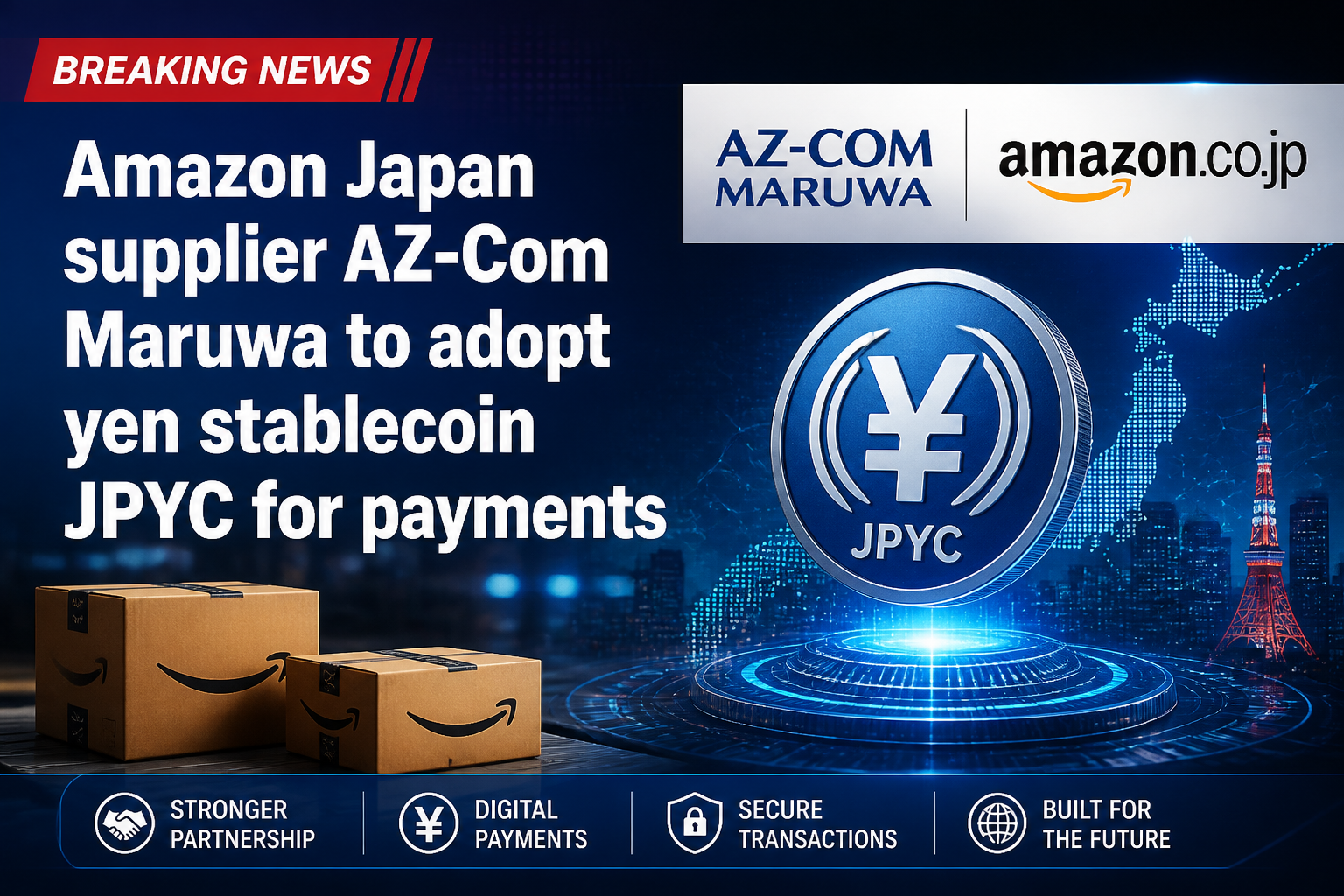
A major Japanese logistics group that serves Amazon Japan is to start paying thousands of business partners in a yen-pegged stablecoin, in what is being billed as the country’s first large-scale corporate use of digital yen tokens for everyday operations.
Amazon-linked logistics group turns to digital yen
AZ-COM Maruwa Holdings, a Tokyo-listed logistics company, plans to settle fees and other payments to about 2,300 partners – including subcontractors and independent truck drivers – using the regulated stablecoin JPYC, according to Nikkei Asia.
The group, which posted revenue of 230.5bn yen ($1.4bn) for the financial year to March, has been providing delivery services for Amazon Japan’s e-commerce operations since 2017. Its decision to introduce stablecoin payments marks a significant step in the spread of tokenised assets into Japan’s mainstream corporate sector, even as broader cryptocurrency markets continue to struggle in a prolonged downturn.
JPYC is Japan’s first fully regulated yen stablecoin. Issued by Tokyo-based fintech JPYC Inc, it was launched in October last year under the revised Payment Services Act and is structured to maintain a strict one-to-one peg with the Japanese currency. The token is fully backed by bank deposits and Japanese government bonds, and its on-chain circulation recently exceeded 2bn yen.
Faster payments amid labour shortages
AZ-COM Maruwa aims to use JPYC to speed up cash flow to drivers and smaller logistics contractors at a time when the industry is grappling with severe labour shortages, an ageing workforce and tougher limits on overtime.
By using a stablecoin that can be converted to yen almost instantly and at no cost, the company hopes to make contract and gig-style delivery work more appealing, particularly for independent truck drivers who often face delays in receiving payments.
Near real-time settlement via digital tokens could reduce working capital strain on subcontractors and improve liquidity across the group’s logistics network, which spans thousands of small and medium-sized operators.
Potential investment in JPYC issuer
Nikkei Asia reported that AZ-COM Maruwa is also weighing a formal business alliance with JPYC Inc, the issuer of the token, and is considering investing 1bn yen in the stablecoin project.
Such a move would deepen the logistics group’s involvement in Japan’s emerging digital money infrastructure and could pave the way for further applications of tokenised yen within its operations, from settlement with suppliers to new financial services for drivers.
From retail tests to corporate scale
The logistics initiative comes just days after Japanese convenience store chain Lawson revealed it would pilot JPYC payments at its Takanawa Gateway City outlet in Tokyo from early August.
While Lawson’s trial focuses on consumer payments at the checkout, AZ-COM Maruwa’s plans extend stablecoin usage into large-scale business-to-business (B2B) settlements, signalling rapid progress for regulated digital yen in Japan.
Together, the Lawson experiment and AZ-COM Maruwa’s corporate rollout suggest that stablecoins, once associated primarily with speculative crypto trading, are beginning to be integrated into Japan’s real economy – from everyday shopping to core corporate payment systems.
Analysts say the combination of full regulatory oversight, yen backing via bank deposits and government bonds, and clear convertibility into cash has made JPYC an early test case for how tokenised money could operate within Japan’s tightly regulated financial system.
If AZ-COM Maruwa’s scheme proves successful, other large corporates may follow, potentially accelerating the adoption of regulated yen stablecoins across sectors such as logistics, retail and business services.


