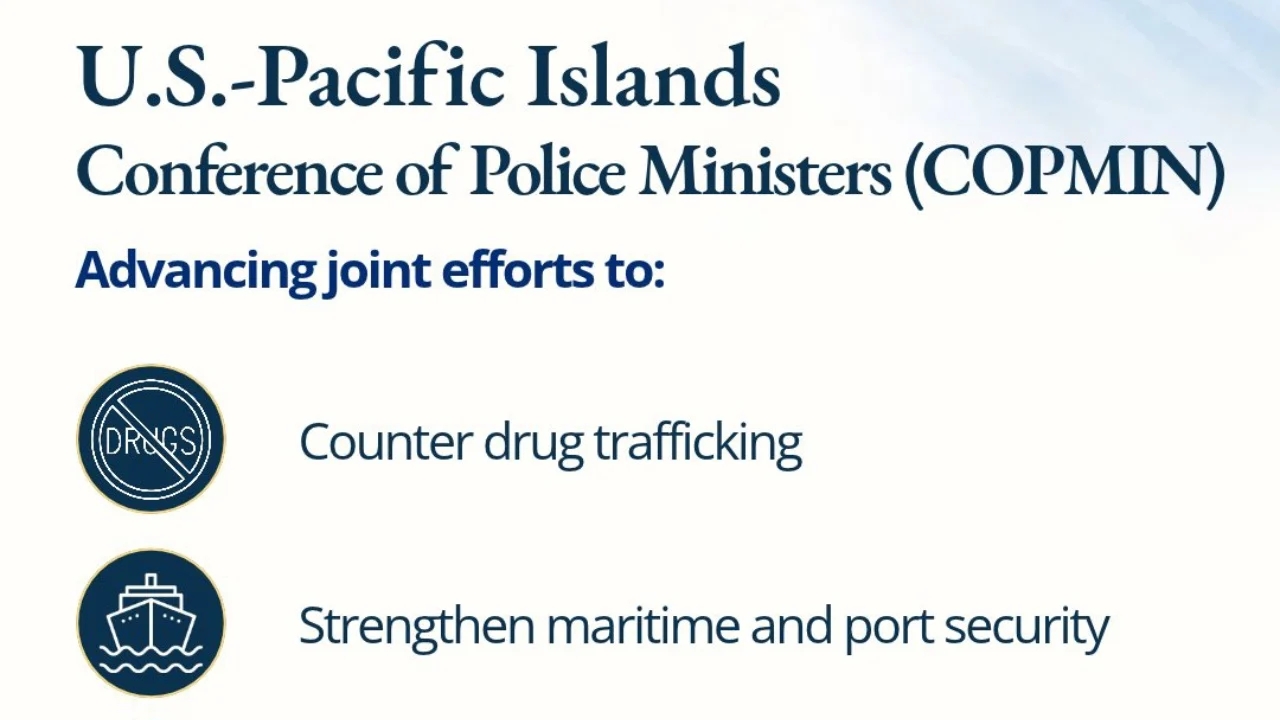
The Trump Administration has announced more than $18m in funding to help Pacific nations disrupt criminal networks, including a $5m programme focused on tracing cryptocurrency used in money laundering.
The investment was unveiled during the first U.S.-Pacific Islands Conference of Police Ministers (COPMIN), where the United States set out a wider package of measures to support a joint regional response to organised crime.
The U.S. Department of State said criminal networks threatening Pacific communities should be treated as one connected enterprise, with action required at every stage of the chain.
“The networks threatening Pacific communities operate as a single criminal enterprise. Each link in this chain depends on the others. Breaking the enterprise requires action at every link, starting where drugs and precursors first enter legitimate trade,” the department said.
More than $44m has been allocated to establish a cross-regional response. The funding is intended to strengthen security across the maritime Pacific, improve long-term cooperation and disrupt the movement of money controlled by criminal organisations.
Almost $18.2m of that investment will be used to improve the ability of Pacific nations to identify and stop financial flows supporting narcotics groups operating across the region.
Of the total, $5m will go to the Pacific Alliance for Combating Illicit Finance and Cybercrime (PACIFIC). The programme is designed to give Pacific island states the expertise and resources needed to identify how digital assets are being used in criminal activity.
As part of PACIFIC, U.S. federal agencies will train law enforcement officers in cryptocurrency tracing, beneficial-ownership investigations and digital forensics.
“They will also help update anti-money laundering and cybercrime laws consistent with Financial Action Task Force and Budapest Convention standards,” said the U.S. Department of State Office of the Spokesman.
The programme will also support changes to the region’s anti-money laundering and cybercrime legislation so that it aligns with standards set by the Financial Action Task Force (FATF) and the Budapest Convention.
The measures reflect the Trump Administration’s broader focus on targeting criminal organisations and cartels in Mexico, including the Sinaloa cartel, over their use of digital assets to launder proceeds from illegal narcotics sales.
“PACIFIC protects the trusted digital economy that U.S. cloud and telecommunications programs are helping build across the region,” the Office of the Spokesman said.
U.S. Indo-Pacific Command is also running a live Bitcoin node and conducting operational tests on the Bitcoin protocol.


