
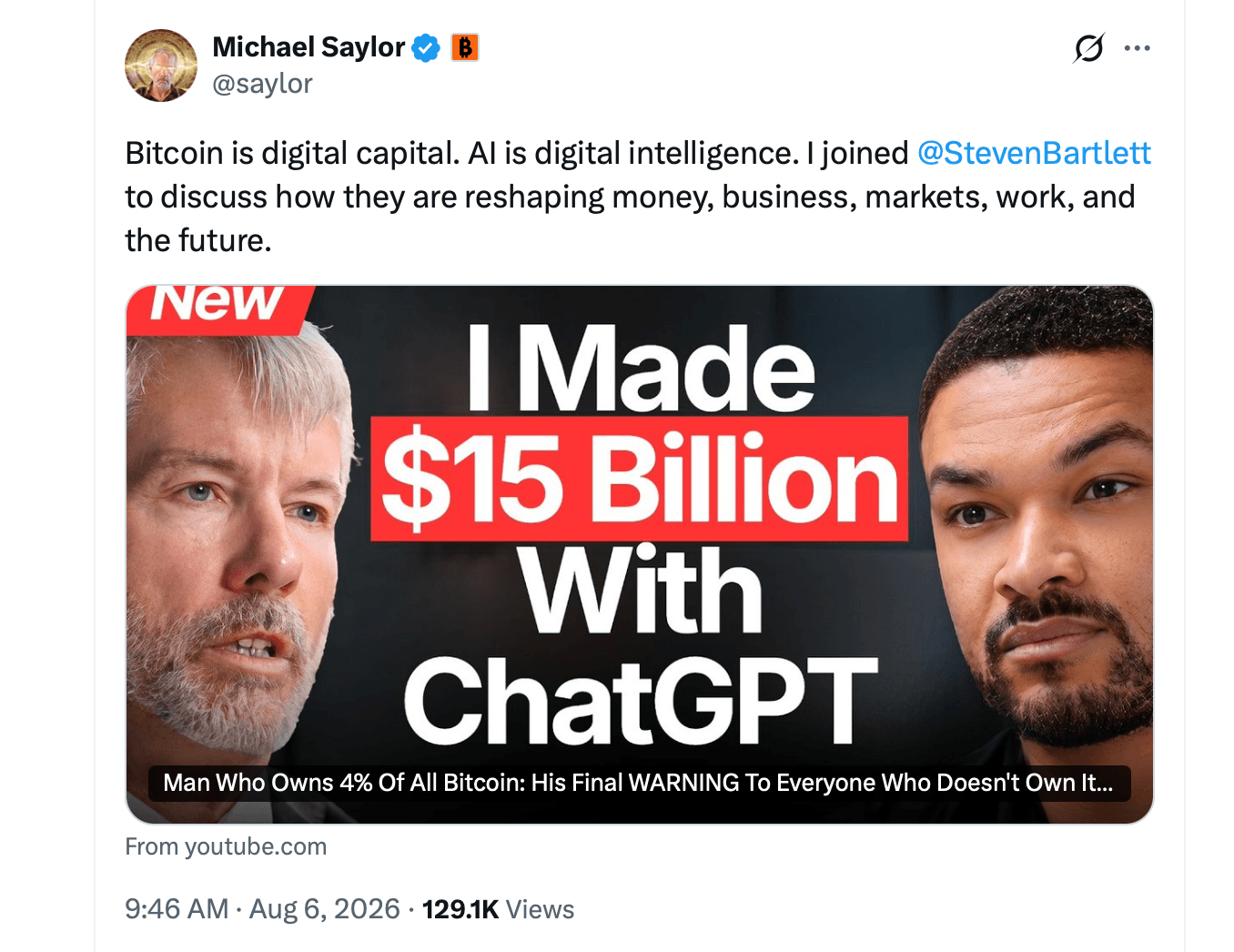
Strategy founder Michael Saylor says artificial intelligence helped the company create a financial product that unlocked about $15bn in capital, in what he described as an example of AI transforming business as profoundly as bitcoin changed digital ownership.
Speaking to Steven Bartlett on The Diary of a CEO podcast, Strategy’s executive chairman said the company used generative AI model ChatGPT after reaching the limits of more traditional ways of raising money. The resulting product, known as STRK, is a preferred stock structure designed to sit between debt and equity while helping Strategy fund further bitcoin purchases.
“Bitcoin is digital capital. AI is digital intelligence,” Saylor said.
Strategy had already become one of the world’s largest issuers of convertible bonds to finance additional bitcoin purchases, according to Saylor. But he said that approach could not continue indefinitely, prompting the company to look for a different type of financial security.
“We used AI to make $15 billion last year,” Saylor told Bartlett.
He said lawyers and investment bankers had initially been reluctant to support the idea because they had not seen a similar structure before. ChatGPT was instead used to generate alternative approaches, which Saylor said helped Strategy develop a product capable of attracting billions of dollars from investors.
Saylor repeatedly presented bitcoin and AI as complementary technologies during the interview. He described bitcoin as the first form of digital capital and AI as the next major advance in digital intelligence.
Bitcoin, he argued, enables individuals and companies to own wealth that can be transferred globally without depending on several financial intermediaries. AI, meanwhile, can expand human productivity by helping people tackle increasingly complex problems.
Saylor urged entrepreneurs not to compete directly with AI, but to use it to develop products and services that previously appeared impossible.
The discussion also returned to his long-running concerns over the loss of purchasing power. Saylor argued that inflation gradually reduces the value of fiat currencies, citing historical examples which he believes demonstrate how the US dollar has lost value across generations.
He contrasted cash with scarce assets including stocks, commercial real estate, gold and bitcoin, which he considers stronger long-term stores of value. Saylor also questioned conventional views on home ownership, saying property taxes, insurance and maintenance can reduce returns from residential real estate in many jurisdictions, despite possible price growth.
Commercial property, he said, may perform better because rental income can often cover those costs.
Bitcoin has a different appeal, according to Saylor. Unlike physical assets, it can be moved across borders within seconds without approval from multiple banks or governments, a feature he said becomes particularly important during periods of economic or political uncertainty.
The conversation then broadened to AI’s impact on employment. Saylor predicted that automation would affect many forms of knowledge work, including accounting, legal research and document preparation.
He does not believe that will stop people from creating value. Instead, he expects more careers to involve directing AI rather than completing repetitive tasks manually. He encouraged young people to learn technologies that are still moving up the innovation “S-curve”, rather than focusing only on industries that have reached maturity.
Saylor also rejected the idea that AI could make money unnecessary. Responding to comments from Elon Musk about a future of material abundance, he argued that while technology may reduce the cost of everyday goods, scarce assets will remain and wealth and capital will therefore continue to matter.
He described both bitcoin and AI as technologies still in the early stages of adoption. In his view, companies combining digital capital with digital intelligence could create new financial products and business models in the years ahead.
Strategy continues to expand and adapt its bitcoin-focused corporate strategy, while Saylor increasingly portrays AI as the tool that can drive the company’s next phase of growth. He told the backers of a contested Bitcoin proposal to “stand down” this week, days before a deadline.
Whether his broader predictions prove accurate remains uncertain, but Saylor’s message is clear: he sees bitcoin and artificial intelligence not as separate trends, but as technologies that could shape the next generation of finance and entrepreneurship.


