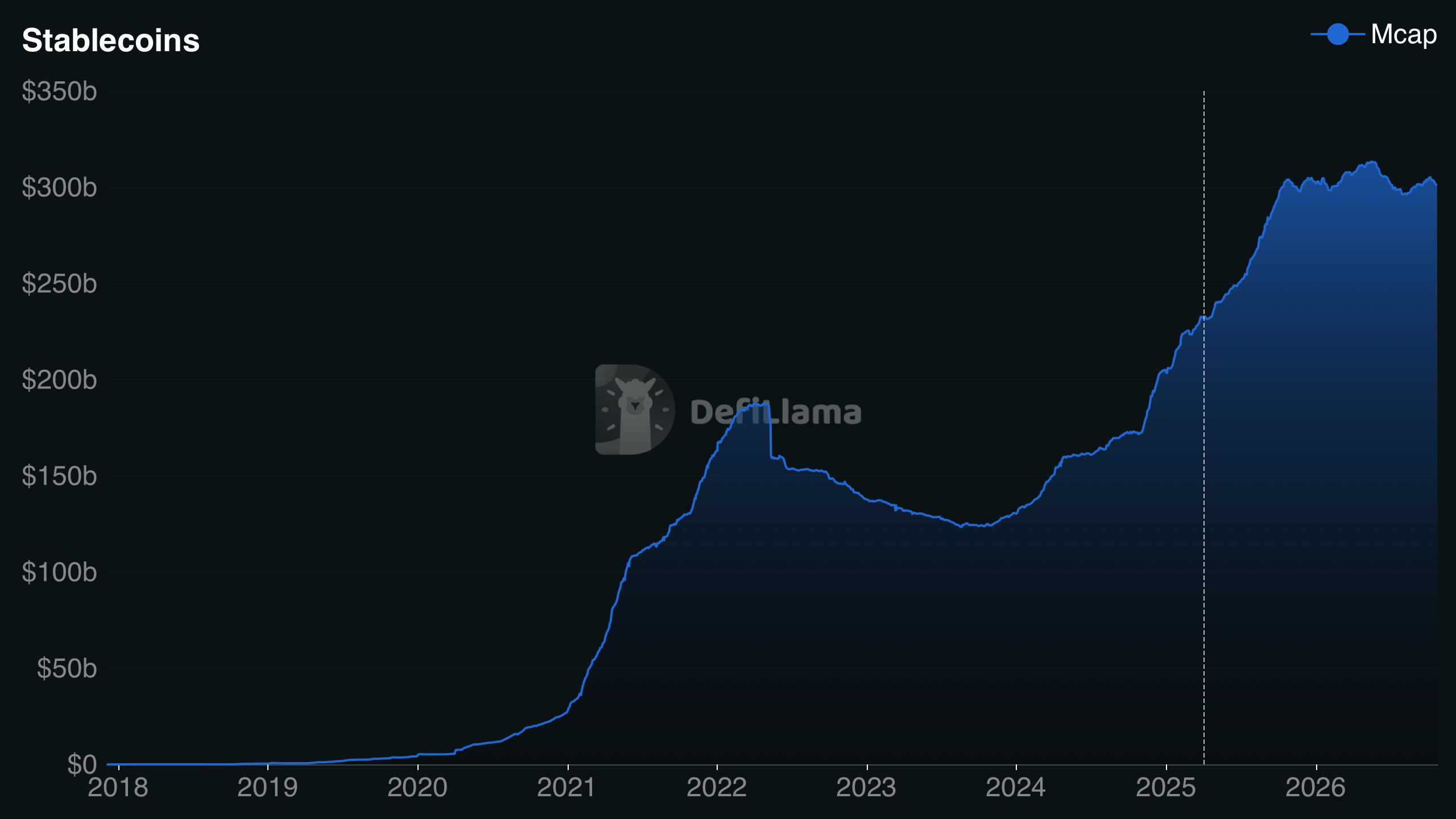
The stablecoin market has shrunk by $12.73bn since 22 May, falling to $300.36bn on 25 October 2026, with Tether’s USDT and Circle’s USDC accounting for most of the decline.
USDT remains the dominant stablecoin, holding 60.74% of the market, but the retreat has prompted traders to reassess how much buying power remains available for cryptocurrencies. The traditional view is that a falling stablecoin supply leaves investors with less capital to deploy in bitcoin, ethereum and other digital assets.
However, a reduction in supply does not necessarily mean the money has left the crypto market.
Data from Defillama showed USDT had a market capitalisation of $182.423bn on 25 October, down $990.43m over seven days and $1.29bn over 30 days. USDC’s market capitalisation stood at $71.743bn after falling by $878.72m in one week and $4.69bn over the month.
Across the 15 largest stablecoins, the combined seven-day decline was approximately $1.90bn. Of the 13 tokens with monthly figures available from Defillama, the net reduction was $5.82bn, with USDC responsible for about 80% of the fall.
Ethena’s USDe lost $305.61m over 30 days, while World Liberty Financial’s USD1 fell by $444.67m, a decline of 10.10%. Some stablecoins expanded during the same period: Paypal’s PYUSD grew by $239.53m, while Falcon’s USDf increased by $511.16m, or 42.32%.
Stablecoins provide readily available liquidity for crypto traders, allowing them to move between digital assets without repeatedly converting funds through traditional banks. Minting generally increases the circulating supply, while redemptions for fiat currency reduce it.
That link has led traders to view prolonged stablecoin contractions as a negative signal for crypto prices. The 2020-2021 bull market and later recovery coincided with stablecoin growth, while the contraction after Terra’s 2022 collapse accompanied a prolonged downturn.
Bitcoin’s current price, near $80,000, is also well below its October 2025 record of about $126,000. But supply data alone cannot show whether redemptions caused selling or simply reflected weaker market conditions.
A further complication comes from tokenised US Treasury products such as BlackRock’s BUIDL and Ondo’s USDY. These yield-bearing products saw their combined capitalisation fall from $16.2bn on 12 August to $14.65bn on 25 October, a $1.55bn decline, according to rwa.xyz logs.
Those redemptions may have been used to buy stablecoins, acquire riskier assets or transfer funds back into conventional financial accounts. Regulatory conversions, changing collateral preferences and faster trading activity can also alter stablecoin balances without reducing deployable liquidity by the same amount.
The contraction is real, particularly USDC’s multibillion-dollar decline, but total supply is an imperfect measure of investor intentions. Exchange balances, issuance, redemption destinations and flows into yield-bearing assets provide a clearer view of the capital still available to the market.
Feature image: Defillama.com seven-day metrics.


