
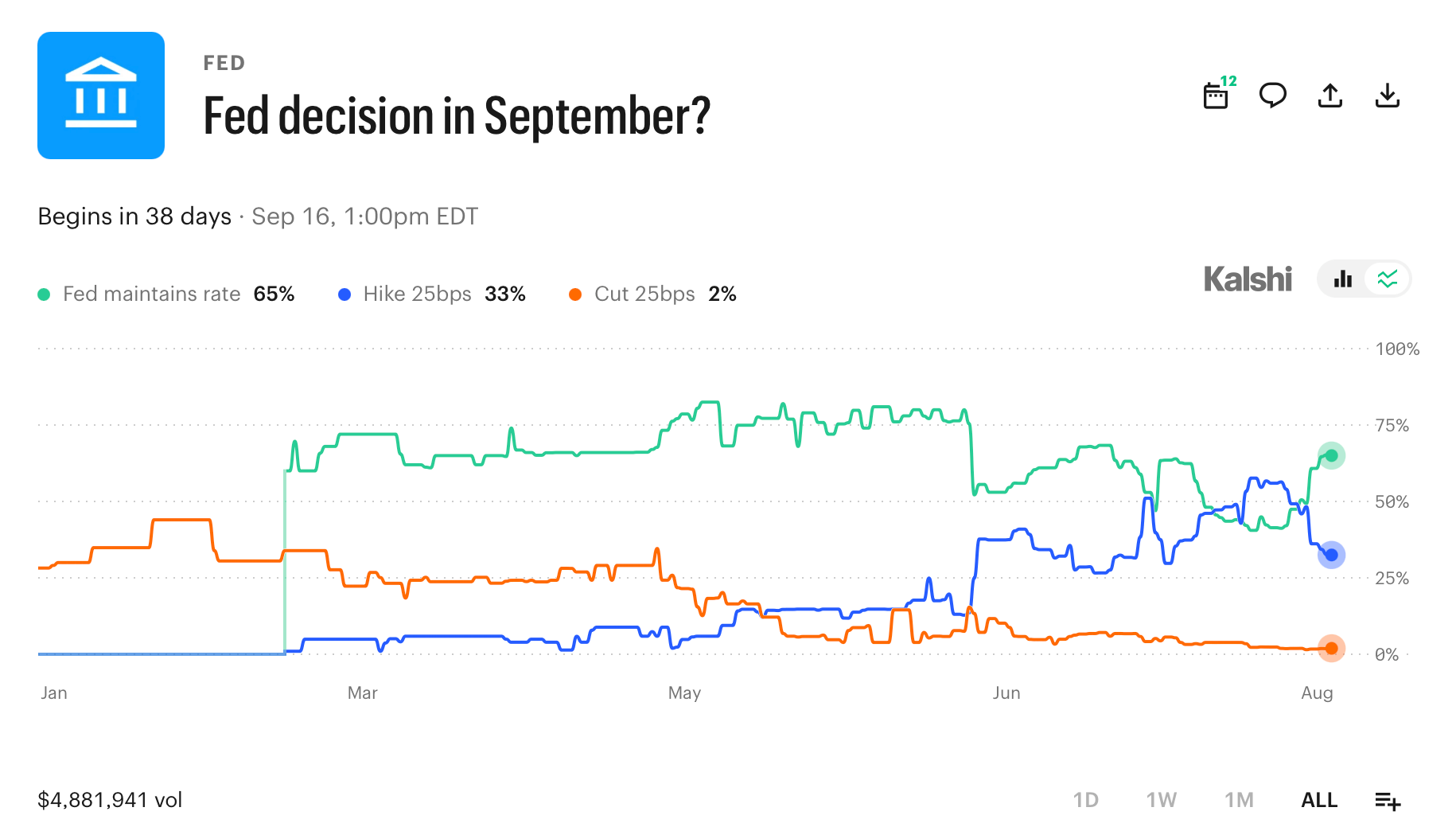
Prediction markets have moved decisively towards the US Federal Reserve leaving interest rates unchanged in September, although pricing across the main indicators shows the decision is far from settled.
Polymarket gives a 63% probability of no change, while Kalshi puts the prospect of rates being held at 65%. The CME FedWatch tool is less confident, assigning a 55.6% chance that the Fed maintains its target range at 3.50% to 3.75%.
The figures leave a quarter-point increase as the only realistic alternative. A cut is barely being considered by traders, with Polymarket pricing that outcome at 1.6% and Kalshi at 2%.
Polymarket’s “Fed Decision in September?” market has recorded more than $20.3m in trading volume. Its contracts for no change are trading at 63 cents, which implies a 63% probability, while a 25-basis-point increase is priced at 36%.
Kalshi’s September Federal Reserve decision market has attracted almost $4.9m in volume. It gives a hold a 65% chance, compared with 33% for a 25-basis-point rise. A basis point is one-hundredth of a percentage point, so a 25-basis-point move is equivalent to a quarter of a percentage point.
The combined activity in the two prediction markets means more than $25m has been traded on the September decision. Their significance lies in the fact that traders are committing money to the outcomes rather than simply expressing an opinion in a survey or market commentary.
Both markets currently place a pause about 30 percentage points ahead of a rate rise. However, the CME FedWatch tool presents a much closer contest.
It calculates a 55.6% probability of no change on 16 September and a 44.4% chance of a quarter-point increase. The estimates are based on prices in 30-Day Federal Funds futures, which traders use to position themselves around expectations for future Federal Reserve policy.
That makes CME’s measure the most hawkish of the three. Its implied probability of a hike is between nine and 11 percentage points higher than the figures on Polymarket and Kalshi. Although all three indicators favour a hold, futures traders are clearly not treating a September pause as a settled outcome.
The CME figures have changed sharply in a short period. On 31 July, the tool showed a 67% probability of a quarter-point increase and only a 33% chance of rates being left unchanged, according to the supplied market data. The current 55.6% probability of a hold therefore represents a substantial reversal in just over a week.
The shift gathered pace after the July employment report showed non-farm payrolls falling by 23,000, while unemployment remained at 4.1%. The weaker labour-market picture gave traders fresh reason to question whether the Fed would raise borrowing costs again so soon. The Bureau of Labor Statistics published the report on 7 August.
The prediction markets responded by strengthening the case for a pause, while futures pricing moved closer to an even split. The difference reflects the way the three markets measure expectations, but their broad conclusion is similar: a rate cut is barely on the table, and the September meeting is primarily a choice between no change and a quarter-point hike.
The Fed left its target range at 3.50% to 3.75% at its meeting on 28-29 July. Its next meeting is scheduled for 15-16 September, with the policy decision due on 16 September.
Inflation data will provide the next major test for the market’s current view. A stronger-than-expected reading could quickly increase the 33% to 44.4% probabilities attached to a hike, while softer price pressures would probably encourage more traders to back a hold.
For now, the numbers favour a pause but offer no certainty. Polymarket puts the chance at 63%, Kalshi at 65% and CME FedWatch at 55.6%. The key question is whether forthcoming inflation and labour-market data can sustain that position before the Federal Reserve makes its decision on 16 September.


