
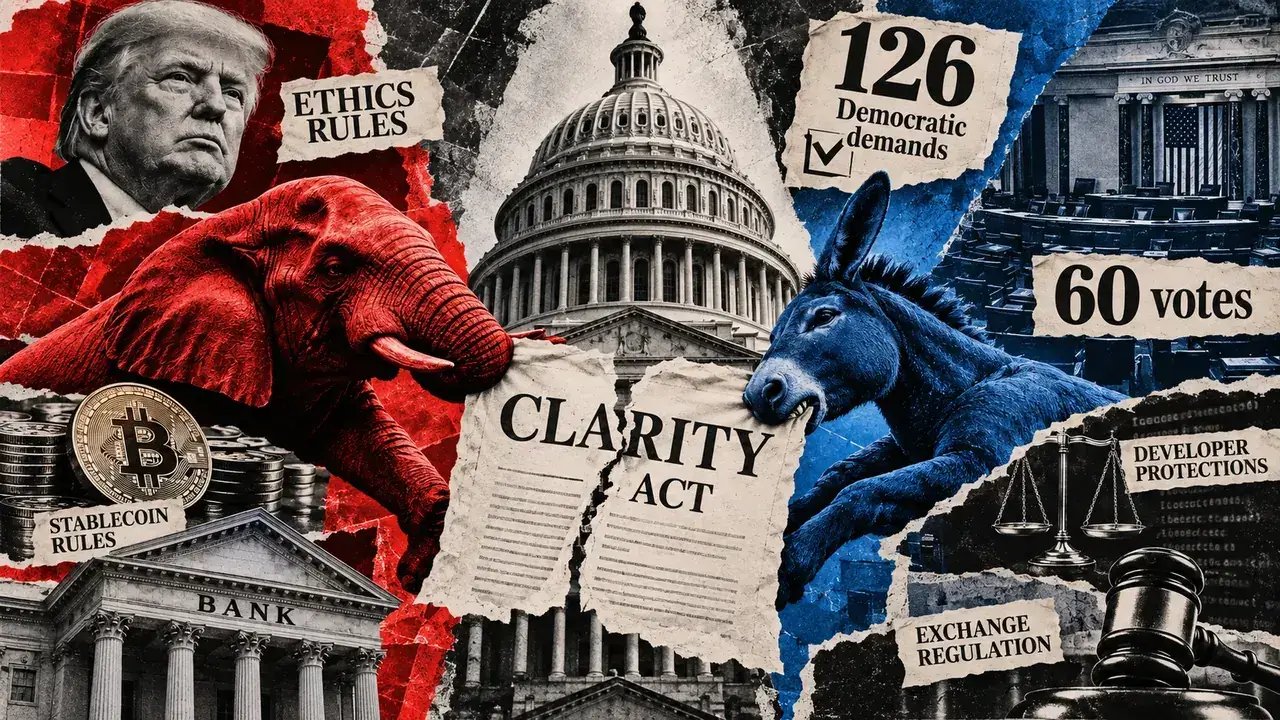
Senate Republicans have made a final series of changes to the CLARITY Act in an effort to win Democratic support before a key vote on Tuesday.
The revised bill includes 126 substantive changes requested by Democrats during more than a year of negotiations, according to Republicans. Sen. Cynthia Lummis, Senate Banking Committee Chairman Tim Scott and Senate Agriculture Committee Chairman John Boozman released the final draft on Monday.
“This text is truly bipartisan and includes more than 120 of Democrats’ demands,” Lummis said.
The latest amendments focus on four unresolved areas: ethics rules for federal officials, safeguards for community banks facing stablecoin-related deposit withdrawals, the legal protection available to software developers, and stricter regulation of digital commodity intermediaries.
The Senate is due to hold a 60-vote cloture test on the motion to proceed to H.R. 3633 at 2:15 p.m. on Tuesday. If cloture succeeds, Republicans plan to introduce the final version as a substitute amendment and begin formal Senate consideration. The vote would start the next stage of debate and amendments rather than complete passage of the CLARITY Act.
Ethics restrictions and stablecoin safeguards
Under the new ethics provisions, state attorneys general would be able to enforce restrictions on covered federal officials who issue or sponsor digital assets, or hold significant financial interests in digital asset issuers.
Those officials would have to sell the interests or place them in a qualified blind trust. A breach could result in a civil penalty equal to 20% of the consideration received in a prohibited transaction or $500,000, whichever is higher.
The rules would take effect 360 days after enactment or 60 days after the final implementing rule, whichever comes first. Republicans said the language incorporates substantially all of an ethics proposal supported by Republican Sen. Thom Tillis and Democratic Sen. Ruben Gallego. They also said President Donald Trump agreed to the restrictions during negotiations.
The bill would create a separate “circuit breaker” for community banks. If the Treasury secretary determined in writing that substantial deposit flight was taking place, Treasury would be required to create rules limiting rewards available to holders of payment stablecoins. That power would expire 18 months after enactment.
Section 404 already prevents covered digital asset service providers and affiliates from paying US customers interest or yield simply for holding payment stablecoins. Activity- and transaction-based rewards could continue under future rules, but firms could not market stablecoins as bank deposits, investment products, government-backed products or FDIC-insured products.
Developer protections and market oversight
The final draft removes language that could have extended the Blockchain Regulatory Certainty Act into criminal money-transmission cases. It still protects software developers from being classified as money transmitters or financial institutions under the Bank Secrecy Act solely because they create software, while now also covering miners and validators.
However, references to 18 U.S.C. 1960, the federal criminal law concerning unlicensed money-transmitting businesses, have been removed. Republicans describe the change as limiting the protection to civil matters, including the Bank Secrecy Act. Certain protections in the Agriculture title apply only to cash and spot transactions, leaving derivatives outside the shield.
The Agriculture provisions also introduce tighter conflict-of-interest rules for digital commodity exchanges, brokers and dealers. The Commodity Futures Trading Commission (CFTC) would establish rules covering affiliated businesses and entities with multiple registrations, including vertically integrated trading groups.
Exchanges would not be forced to separate affiliated companies. Instead, the CFTC could address conflicts through governance, disclosure, capital and customer-protection requirements, while avoiding duplicative or unnecessarily burdensome rules.
The text preserves state consumer-protection laws and says developer protections cannot exempt firms from derivatives law or affect tribal gaming. Republican materials also say the bill does not change the legal framework for prediction markets.
Securities, enforcement and consumer measures
Other changes reduce the annual Regulation Crypto fundraising limit from $75 million to $50 million and introduce a $200 million lifetime cap. Originators raising more than $25 million would need audited financial statements, while the ownership threshold triggering certain resale restrictions falls from 5% to 3%.
The bill preserves SEC authority over fraud and market manipulation, as well as state consumer-protection remedies. It would also introduce best-execution rules, whistleblower protections, certified annual financial statements and restrictions on exchanges using their own digital commodities to meet capital requirements.
The CFTC would receive an Office of the Retail Commodity Advocate and $150 million in funding.
Digital commodity brokers, dealers and exchanges would be brought under Bank Secrecy Act and sanctions-compliance requirements. Treasury would gain wider authority over foreign digital asset transactions linked to major money-laundering concerns, while temporary holds on suspicious transactions would be permitted in specified circumstances without civil liability.
Crypto kiosk operators would face registration, fraud-warning and disclosure obligations, as well as a 72-hour holding period for certain transactions involving new customers. The bill would also establish a Digital Asset Cyber Innovation Center and provide $150 million to the Financial Crimes Enforcement Network to expand anti-money-laundering capacity.
The additional measures respond to concerns raised in July by seven Democratic senators, including Gallego, Mark Warner and Cory Booker, who said an earlier Republican draft did not do enough on ethics, consumer protection, illicit finance, conflicts of interest and market integrity.
Lummis said Democrats had won more than 120 of the changes they requested. She added:
“If the Clarity Act fails, Democrats own what comes next: more 100 Democratic-directed changes wasted, consumers with zero federal protection, no disclosure rules, no delisting requirements for bad actors, stuck in the same unregulated system that has already cost Americans billions. They wrote the fix. They must pass it.”
The remaining question is whether the Democrats whose objections led to the revisions believe the final wording goes far enough.


