
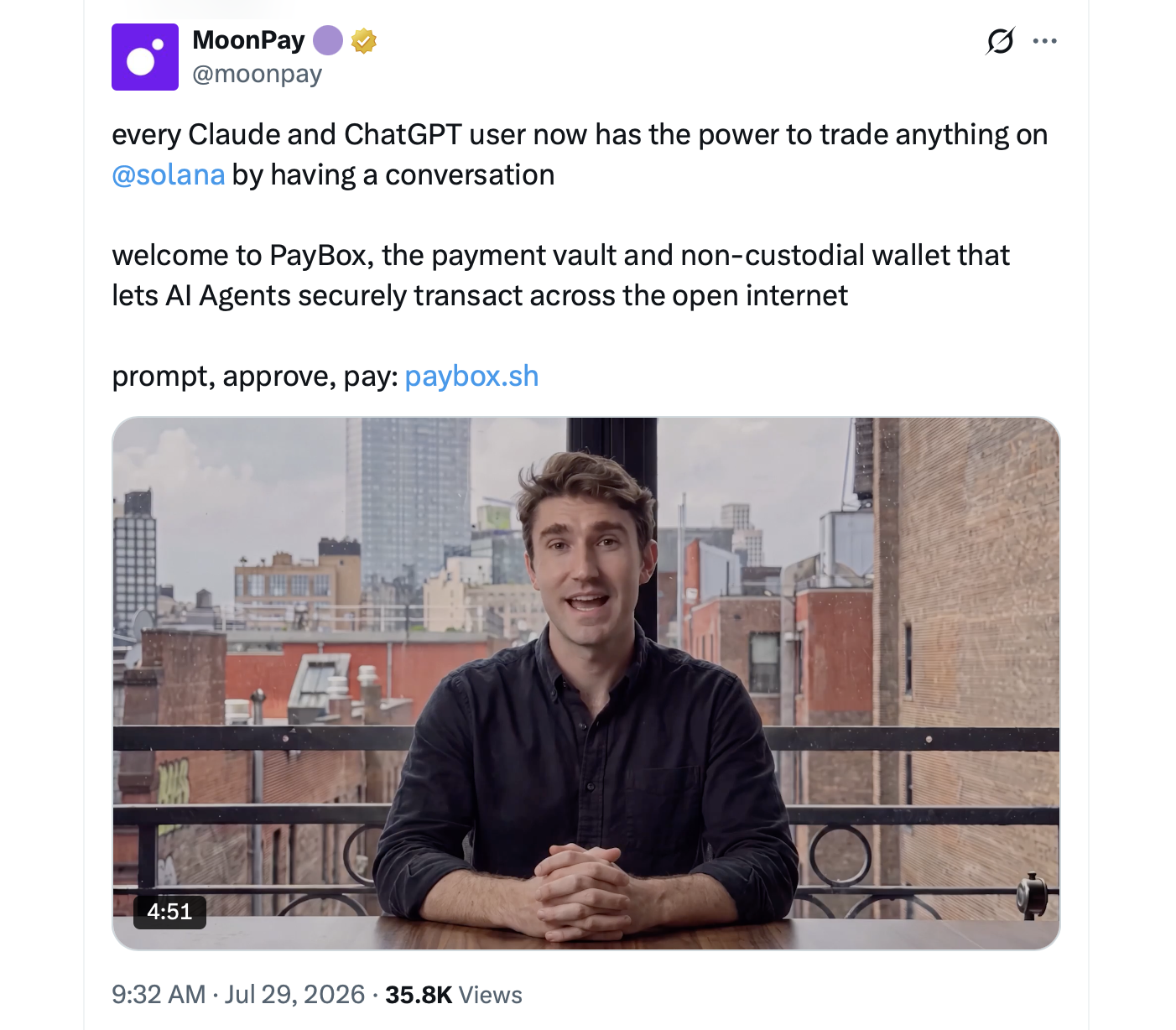
Moonpay has introduced a new payments vault designed for artificial intelligence agents, allowing users of Claude and ChatGPT to trade tokens, book travel and move money while keeping full control of their funds.
The product, called PayBox, links directly to Claude or ChatGPT via a custom connector so that users can issue plain-language instructions, such as moving $100 into PYUSD or swapping tokens for SOL. The AI system then assembles the transaction details, but the transfer only goes through once the user has authorised it with a passkey.
Previously, AI assistants could help answer questions and automate tasks, but actually executing payments or crypto trades typically required separate tools such as terminals, developer platforms or third‐party custodians. Moonpay’s new vault is intended to remove that extra step while maintaining strict control over who can move money and when.
Security by design
Moonpay says the core design principle is that no single party – not Moonpay, not the AI agent, and not the user’s device – can access a complete private key or sign a transaction alone.
Wallet keys are divided using multiparty computation and stored in secure hardware enclaves, meaning that even if one element is compromised, an attacker cannot move funds on their own. Payment cards are saved in a form that lets an AI agent initiate charges without ever viewing the actual card number, using Visa’s agentic commerce protocol.
Users can choose from two permission models for how their AI agent operates, but in every case, any change in permissions requires a fresh passkey confirmation from the person controlling the account. Each approval covers only a single action, cannot be reused, and can be withdrawn at any time.
Tackling agentic fraud
According to Moonpay, fraud involving AI‐driven transactions typically stems from stolen login details, exposed card data or a single system that can send funds once breached. The company argues that PayBox is structured to confront each of these risks.
By splitting wallet keys, a hacked phone or computer alone is not enough to move assets, as no device holds a full key. Visa’s protocol ensures that raw card numbers are never present in the transaction flow. Single-use passkey confirmations are designed to prevent captured approvals being replayed or turned into broader, ongoing access.
“The card hid the cash. The phone hid the card. This is the era where money disappears into conversation. Billions of AI agents are coming online, and every one of them will need to hold, move, and spend money safely. Someone had to build the trust layer for that world. We just did,” said Ivan Soto-Wright, Moonpay’s chief executive and founder, in a statement released with the launch.
Technical backbone and network support
The vault runs on infrastructure from Sodot, a key-management specialist that Moonpay acquired earlier this year. Sodot currently secures more than $50bn in assets and over 10 million wallets for crypto firms, and Moonpay is combining that technology with its base of more than 1,700 enterprise clients.
At launch, the vault supports Solana and EVM-compatible networks, including Ethereum, Base, Arbitrum, Polygon, Hyperliquid, Tempo and Robinhood Chain, with further integrations in development. Payments are routed through x402, an open standard for AI‐initiated transactions, allowing agents to pay any service that is set up to accept that format.
Moonpay says restaurant reservations, travel bookings and shopping with major online retailers are already live through this system, with new partnerships scheduled to go live on a weekly basis.
Next steps for AI and DeFi
The company plans to extend PayBox beyond Claude and ChatGPT, with support for additional AI platforms described as “coming soon”. Deeper connectivity with decentralised finance (DeFi) protocols is also on the roadmap.
Future capabilities are expected to include enabling AI agents to route token swaps, trade perpetual futures and manage liquidity positions, all under the same user-controlled approval framework. For traders already using Claude or ChatGPT to analyse markets, the update is intended to turn those research conversations into direct onchain execution, without surrendering control of wallets or private keys.
Separately, Moonpay has confirmed that it now accepts Discover Network payments, giving US users a third major card option when buying cryptocurrency through its platform.


