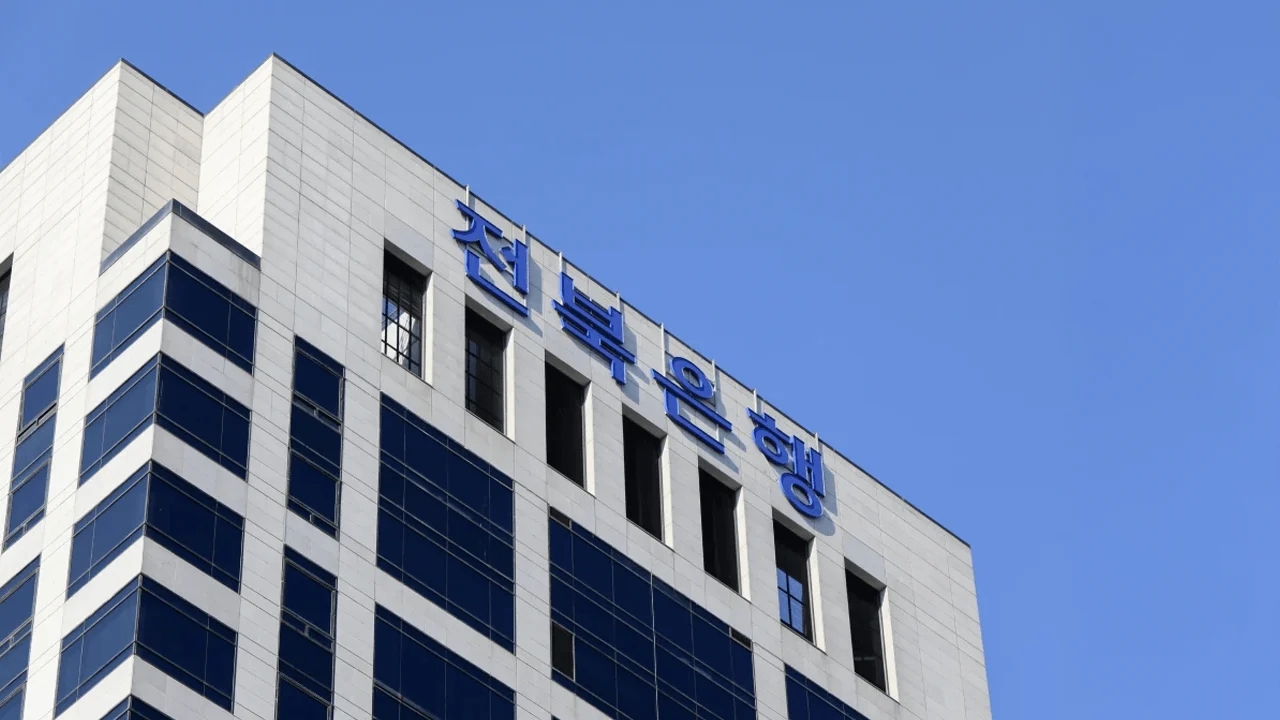
Jeonbuk Bank has issued South Korea’s first reported traditional bank loan secured by bitcoin, allowing companies to raise Korean won without selling their cryptocurrency or transferring ownership to the lender.
The subsidiary of JB Financial Group has introduced a restricted corporate lending arrangement in which bitcoin is posted as collateral but remains outside the bank’s custody. The development was first reported exclusively by regional publication Edaily and reporter Lee Jeong Hun.
Licensed third-party custodians will hold the bitcoin, while Jeonbuk Bank carries out credit assessments, values the collateral and issues the loans. The facility is available only for corporate working capital, such as payroll, supplier payments and routine operating costs.
Individuals cannot use the service, and bitcoin (BTC) is currently the only digital asset accepted as collateral.
South Korean reports differ on the precise status of the arrangement. Edaily described it as a limited service launch, while Maeil Business Newspaper reported that it was a pilot involving an existing corporate loan.
The key feature of the model concerns what happens if a borrower fails to repay. Under revised Civil Enforcement Rules that take effect on Oct. 1, 2026, Jeonbuk Bank will be able to seek court-supervised recovery without taking possession of the bitcoin.
If ordered by a court, the collateral can be sold and the proceeds used to reduce the outstanding debt. This allows the bank to operate within existing lending rules while avoiding direct custody of cryptocurrency.
The custodians holding the bitcoin must meet South Korea’s regulatory requirements. These include registration, security certification, segregation of customer assets and applicable cold-storage obligations.
Jeonbuk Bank chose bitcoin because of its substantial market capitalisation, trading liquidity and established price discovery. The bank is also reported to have carried out internal stress tests assessing how the asset would perform as collateral during sharp market falls.
Its valuation system combines weighted prices from several international exchanges with volatility indicators, in an attempt to limit distortions in the price used for lending decisions.
The bank has not disclosed the loan’s interest rates, loan-to-value ratios, liquidation thresholds or maximum loan amounts. The identity of the borrower has also not been made public.
The arrangement marks a practical step in South Korea’s efforts to connect digital assets with traditional finance. Jeonbuk Bank has previously examined blockchain-based payments, settlements, remittances and stablecoins, and is developing an integrated wallet linking conventional bank accounts with digital assets.
The lender intends to improve its monitoring and recovery systems before deciding whether to accept other cryptocurrencies or extend the loans to additional purposes.
For businesses holding bitcoin, the arrangement offers access to Korean won without requiring an immediate sale. However, the undisclosed commercial terms and restriction to corporate borrowers mean the scale of South Korea’s experiment remains limited.
Bitcoin was trading at about $82,550 to $83,000 on Monday, Oct. 12, 2026, while technical indicators presented a largely neutral picture.


