
A steep slide in Japanese government bonds could trigger a wider US financial crisis and burst the American debt “bubble”, according to economist Peter Schiff, who also believes investors are finally starting to question the huge sums being poured into artificial intelligence.
Speaking on The Peter Schiff Show Podcast, the long-time Bitcoin critic said a bruising week for leading technology names exposed cracks in the AI trade, even as major stock indices remained relatively resilient.
Alphabet shares dropped 10% after the company signalled higher-than-expected capital expenditure, particularly on AI infrastructure. Oracle fell nearly 8% over the week and is now 41% lower for the year, while Meta slid 7.3%, Amazon declined 6.8% and Microsoft lost 2.7%, leaving it 19.3% down so far in 2024 – close to what is typically viewed as bear-market territory.
Schiff argued that this marks a change from previous quarters, when announcements of bigger AI budgets from hyperscale technology firms were routinely rewarded with higher share prices. “Investors are now finally starting to question whether or not these investments are in fact going to pay off,” he said.
Tech valuations and AI spending under scrutiny
Schiff compared the current wave of AI-related investment to the late-1990s internet boom, saying that around three-quarters of a trillion dollars in annual AI capital expenditure is being deployed in a way that resembles the build-up to the dot-com crash.
He noted that many early internet companies that received large capital injections never generated sufficient returns and ultimately went bankrupt, without ever earning back what had been ploughed into them. While he said he does not dispute AI’s long-term potential, he believes markets are overestimating how quickly hyperscaler spending will translate into profits.
Privately held SpaceX also came under pressure, with its shares falling a further 7.7% over the week and now trading 49% below their post-IPO peak. Schiff highlighted that the company’s public float is expected to expand sharply from 5% of shares to 40% by the end of the year, something he said could put additional downward pressure on the stock price.
Tesla shares dropped 18% over the same period and now stand 35% beneath their 52-week high. Taken together, the falls in Tesla and SpaceX have reduced Elon Musk’s wealth by close to $100bn in a single week, according to Schiff’s calculations.
Japan’s bond market in the spotlight
Schiff, a long-standing advocate of gold, said developments in Japan pose an even greater and more immediate threat than the tech sell-off.
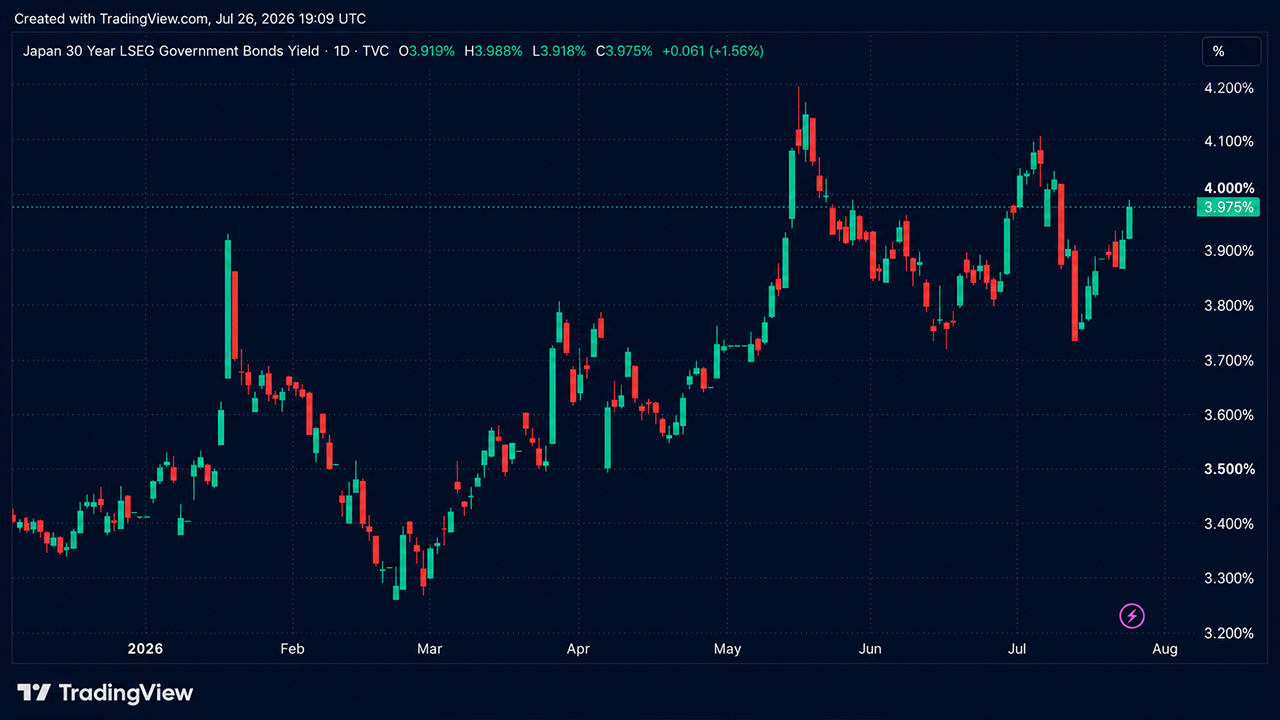
The yen has weakened to its lowest level against the US dollar in 40 years, while Japan’s 30-year government bond yield has climbed close to 4%, a record for that maturity. The yield on 10-year Japanese government bonds has risen to levels last seen in 1996.
Japan’s public debt now exceeds 200% of gross domestic product, yet the Bank of Japan’s main policy rate is just 1%. Schiff said the central bank faces a stark dilemma: either increase interest rates aggressively, risking a domestic recession and a wave of capital being brought back home, or hold steady and run the risk of a full-blown currency crisis. Either option, he argued, carries major implications for the United States.
Japan owns more than $1.1tn in US Treasuries, the largest foreign holding of American government debt. Schiff warned that a serious Japanese debt crisis could force Tokyo to sell a substantial portion of those holdings. “It may be the pin that pricks our bubble,” he said, referring to the potential impact on the US economy.
Rising US yields, swelling debt and higher oil
US borrowing costs are already climbing. The 30-year US Treasury yield ended the week at 5.16%, the highest closing level since 2006. Over the same period, US national debt has grown to more than $39.6tn, which Schiff noted is over four times the level of government indebtedness in 2006. That, he argued, makes today’s interest burden far more difficult for Washington to absorb than when yields were last at similar levels.
Oil prices have surged above $100 a barrel and are up about 30% in July alone, a move driven in large part by tensions involving Iran. Schiff said the jump in energy costs “all but guarantees” a stronger reading for the Consumer Price Index when July’s inflation data are published in August.
Gold and miners buck recent pattern
Despite rising bond yields and higher oil prices, gold gained around 1% over the week. Schiff described the move as noteworthy because the metal has generally traded in the opposite direction to oil since the onset of the Iran-related tensions.
Gold-mining shares fared even better, with the GDX index advancing 5.6% and the GDXJ climbing 5.8%. Schiff interpreted the outperformance of miners relative to the metal itself as a possible sign that the sector may be forming a price floor.
Jobs data and tariffs challenged
Schiff also took aim at the Trump administration’s interpretation of labour-market data, questioning the significance of a recent fall in weekly jobless claims to 187,000. He argued that the expansion of gig employment and subdued hiring trends mean that headline jobless-claims figures no longer have the same relevance they did in previous decades.
Separately, he criticised new US tariffs applied to goods from roughly 60 countries under a provision of the Trade Act of 1974 designed to target products linked to forced labour. Schiff labelled the measure an unconstitutional tax that, in his view, will ultimately be paid by American consumers rather than foreign governments.


