
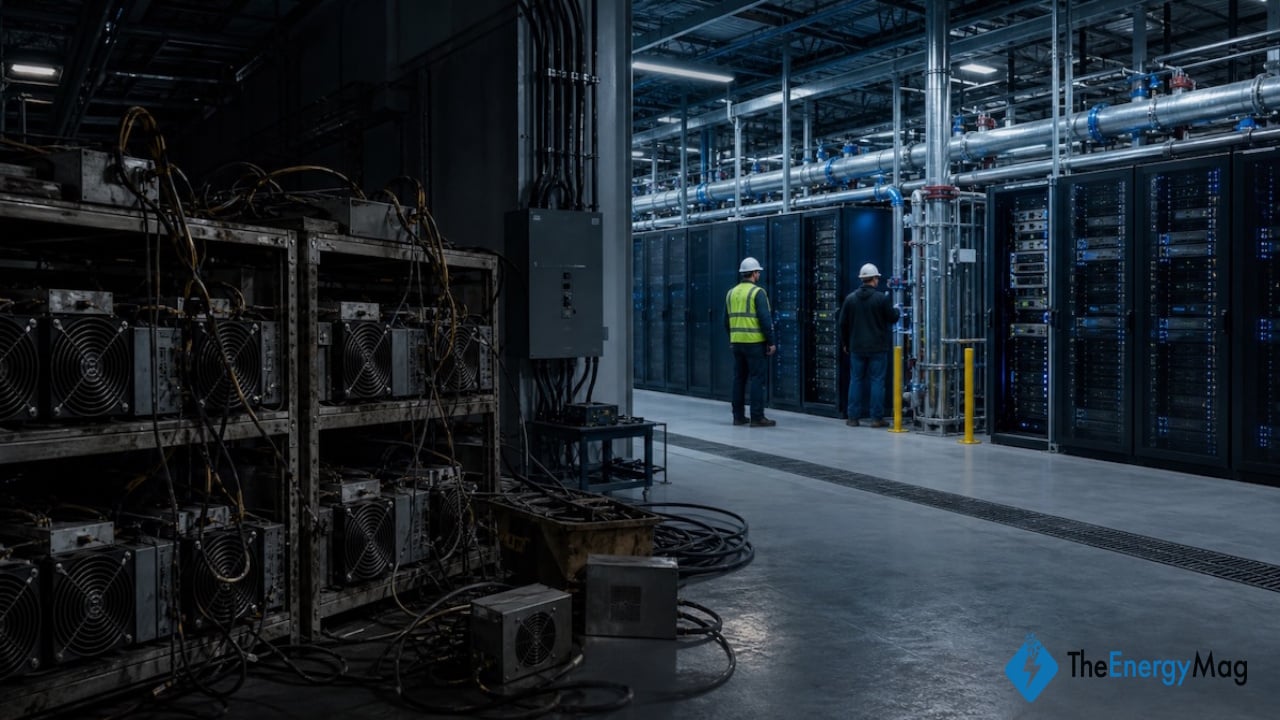
Core Scientific has agreed a $41.9m settlement to end a major bitcoin mining hardware deal with Block’s Proto division, in a move that underlines the company’s rapid pivot away from cryptocurrency mining and towards AI-focused data centre services.
The US-based operator, listed on Nasdaq as CORZ, confirmed in its second-quarter regulatory filing that the payment cancels its existing agreement with Block and Proto and halts all future deliveries of mining equipment. The filing linked the decision directly to the winding down of Core Scientific’s remaining self-mining obligations and its shift to high‐density colocation operations for AI and other compute-intensive workloads.
Core Scientific did not disclose detailed payment terms or timing beyond recognising a $41.9m loss associated with the termination.
Major mining chip order scrapped
The now-cancelled agreement, originally announced in July 2024, would have seen Block’s Proto unit supply 3‐nanometre bitcoin mining chips providing around 15 EH/s (exahashes per second) of computing power. By hashrate, it was one of the largest publicly announced mining‐chip transactions in the sector and included an option for additional volume.
By pulling out of the deal, Core Scientific has effectively removed what had been a potential large-scale expansion of its mining fleet. The company now says it is no longer investing in new mining hardware to sustain or increase its hashrate. Instead, it intends to maximise cash generation from its existing fleet while progressively converting sites for colocation use and selling or decommissioning mining rigs when it judges the timing to be right.
Revenue mix flips from bitcoin to colocation
The change in strategy is already evident in Core Scientific’s financial performance for the second quarter.
Colocation revenue surged to $136.7m, up from just $10.6m in the same period a year earlier. That business line now accounts for 83% of total revenue, compared with only 13% in the prior-year quarter.
By contrast, revenue from self‐mining dropped 66% to $21.5m, down from $62.4m a year before, and represented just 13% of quarterly revenue, compared with 80% previously. Hosting revenue from third‐party bitcoin miners came in at $6m.
The company reported that its bitcoin production during the quarter was 53% lower than a year earlier, while the average realised price it received for bitcoin fell 27% over the same period. Core Scientific has been diverting power away from mining equipment and towards data‐centre capacity dedicated to graphics‐processing units (GPUs) and other high‐density computing systems commonly used for AI workloads.
As of 30 June, Core Scientific said it had 395 megawatts of billable colocation capacity, rising to 437 megawatts by mid‐July. Total leased customer capacity across its portfolio has reached roughly 1.1 gigawatts.
Growing dependence on AI customers
The numbers highlight how Core Scientific, once among North America’s largest publicly traded bitcoin miners, is increasingly repositioning itself as a landlord for AI and high‐performance computing infrastructure.
At present, all of its colocation revenue is derived from CoreWeave Inc. (NASDAQ: CRWV), which accounted for about 77% of Core Scientific’s total revenue in the first half of the year. That concentration leaves the company heavily reliant on a single client, even as it works to broaden its tenant base.
This week, Core Scientific unveiled a separate partnership with Advanced Micro Devices Inc. that could cover up to 2.5 gigawatts of potential data‐centre capacity. Initial 15‐year agreements span about 530 megawatts across five locations and, according to the company, could generate more than $14bn in base contracted revenue over their term.
Investment and balance sheet pressures
Overall, second‐quarter revenue more than doubled to $164.2m from $78.6m a year earlier, driven by the rapid build‐out of colocation services. Capital expenditure also rose sharply, climbing to $797.5m from $121.3m as Core Scientific invested heavily in expanding and upgrading its data‐centre footprint.
As of 30 June, the company reported around $1bn of outstanding purchase and construction commitments, most of which it expects to deploy within the next 12 months. It also disclosed $4.3bn of long‐term debt and $1.82bn of liquidity, underscoring both the scale of its expansion plans and the financial obligations tied to its transformation from bitcoin miner to AI infrastructure provider.


