
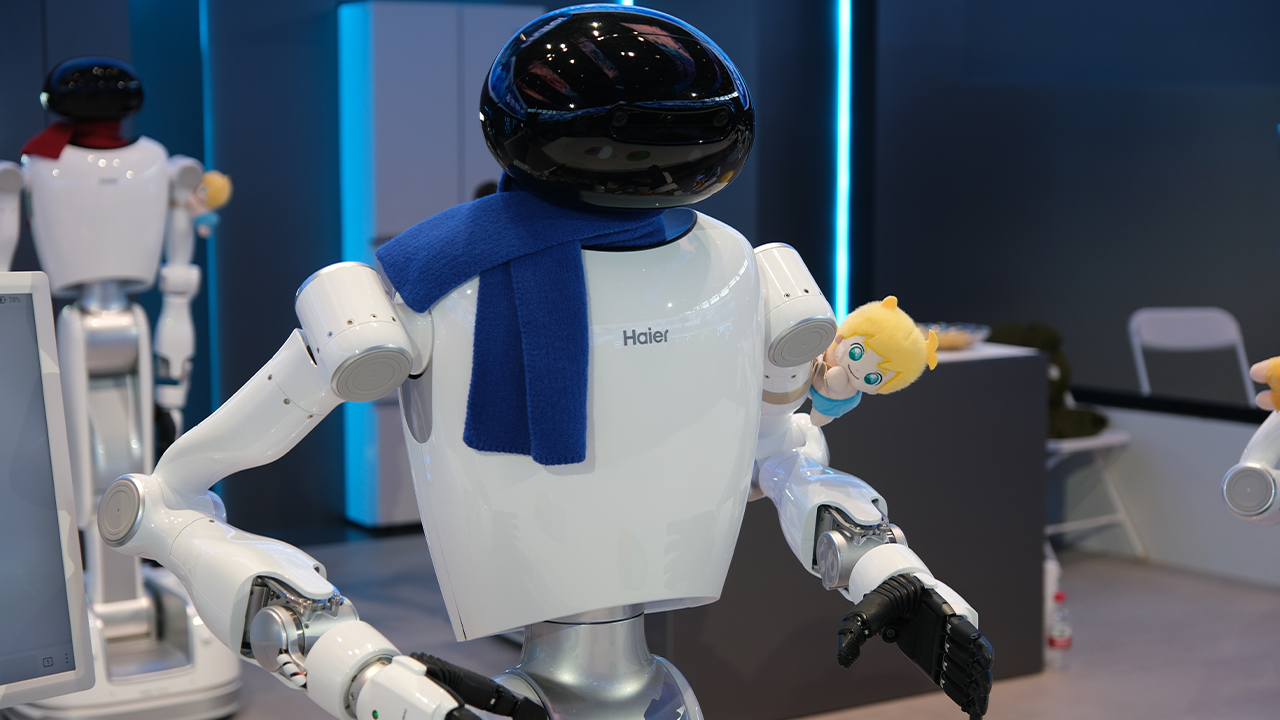
China’s growing humanoid-robot industry is developing a new business model, with thousands of machines now being rented for exhibitions, performances and even marriage proposals rather than bought outright.
More than 5,500 rental orders were recorded in the first three months after AGIBOT launched its SHAREBOT subsidiary in December 2025. Prices on the platform begin at about 3,500 yuan ($517) per day, including delivery and the services of a human operator.
In Hangzhou, e-commerce livestreamer Ai Lin charges 3,000 yuan ($443) a day to rent out his own humanoid robot. The machine has been booked to attract crowds at exhibitions, appear at events and play a role in marriage proposals.
Ai bought his first android for $30,000 in 2025 after watching humanoid robots perform on China’s Spring Festival Gala. He now believes renting offers a more practical way to recover that investment while the market for robot sales remains limited.
“The market for humanoid sales hasn’t really taken off yet because today’s robots still can’t operate on their own,” he said.
The expansion of rental services highlights the difficulties facing robot manufacturers as they try to find immediate, real-world uses for machines that remain expensive and heavily dependent on human support.
AGIBOT, regarded as one of China’s leading humanoid-robot makers, established SHAREBOT as a dedicated rental business in December 2025. The platform’s prices include shipping and an operator who helps control and programme the robot, meaning customers are often hiring both the machine and a small support team rather than an independent robotic worker.
The trend has also attracted investors looking to turn the technology into a short-term commercial asset. Zhao Xiaohong, a 52-year-old investor from Jiangsu, bought eight humanoid robots in 2025 with the intention of renting them out.
He described the approach as “the fastest way to monetize the technology in the short term.”
State-run media has reported that China has more than 153,000 businesses involved in robot rentals. Machines are also being advertised through local online platforms including Xianyu and Douyin, the Chinese equivalent of TikTok, as well as through SHAREBOT.
AGIBOT has estimated that China’s humanoid-robot rental market could be worth $1.5bn by the end of 2026. The rental model is attractive partly because purchasing a machine outright remains beyond the reach of many potential customers. Entry-level humanoid robots cost about $19,000, while more advanced models can sell for more than $100,000.
For businesses seeking to test the technology at an event or short-term project, a daily fee may therefore offer a less risky alternative to buying a robot.
However, CNN Business reported that humanoid robots remain years away from replacing human labour, whether on factory floors or in people’s homes. Their current limitations are underlined by the need for operators to control and programme them during rental periods.
SHAREBOT chief executive Li Yiyan said the rental market could help move the machines beyond demonstrations and towards wider use.
“It ultimately helps robots transition faster from mere exhibition pieces to large-scale deployment,” he said.
China is also attempting to accelerate that process through government policy. Earlier in June 2026, Beijing launched a nationwide initiative to promote the use of humanoid robots in practical settings, with a target of creating more than 100 “high-value application scenarios” by the end of the year.


