
BlackRock’s flagship ether exchange-traded fund drew fresh institutional cash on Monday as bitcoin products suffered a third straight day of outflows, underlining a shift in appetite across the US spot crypto ETF market.
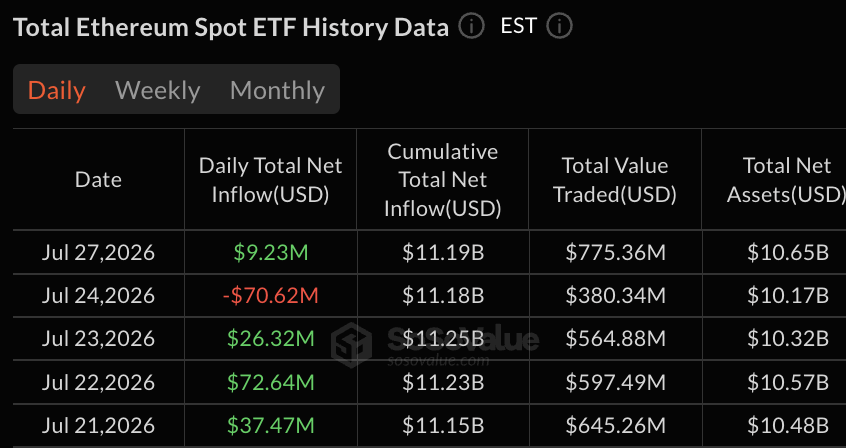
BlackRock’s ETHA fund attracted $11.75m in new money, driving net inflows of $9.23m into US spot ether ETFs on 27 July. Over the same session, bitcoin funds shed $11.64m, continuing a losing streak that started late last week.
The flows highlight how professional investors are becoming more selective in their crypto exposure, with ether and a handful of altcoins seeing net buying while bitcoin and so‐called “HYPE” products come under renewed selling pressure.
Bitcoin ETFs stay in the red
Bitcoin remains the core institutional gateway into crypto, but US spot bitcoin ETFs recorded another day of net withdrawals.
Only two funds saw net flow activity. BlackRock’s IBIT posted the largest move with $8.82m in redemptions, while Fidelity’s FBTC saw $2.82m leave the product. No US spot bitcoin ETF reported any fresh inflows during the session.
Overall trading in bitcoin ETFs reached $1.34bn on Monday, and combined net assets across the category stood at $78.71bn by the close.
Ether products move against the tide
In contrast, ether ETFs drew new capital, led decisively by BlackRock.
The firm’s ETHA fund took in $11.75m, more than offsetting a $2.52m outflow from Invesco’s QETH. That left net inflows for the ether category at $9.23m for the day.
Turnover in ether ETFs totalled $775.34m, with aggregate net assets finishing at $10.65bn.
The divergence between bitcoin and ether has been driven in part by how institutions are now calibrating their exposure, according to Giselle Lai, Director, Digital Assets Strategist at Fidelity International. She told Bitcoin.com News that bitcoin tends to be the first asset institutions use when entering the crypto market, but that ETFs are now giving them tools to fine‐tune their allocations.
Lai said the products are lowering the barrier to entry and helping large investors make more considered portfolio decisions, rather than simply encouraging them to “buy or sell bitcoin”.
Solana and XRP see modest gains
Beyond the two largest cryptoassets, a small number of altcoin funds also attracted institutional demand.
Solana ETFs recorded $1.03m in net inflows, with the bulk of that money directed into Bitwise’s BSOL product. Trading value for Solana ETFs reached $39.55m, and net assets across the segment closed at $889.31m.
XRP products added a more modest $592,470. All of that inflow went into Franklin Templeton’s XRPZ fund. Across all XRP ETFs, trading value stood at $12.66m, while combined assets were held at roughly $1bn.
HYPE segment struggles after strong debut
The weakest area of the US spot crypto ETF market on Monday was the group of HYPE-branded funds, which continued to lose ground after what had been a strong launch phase.
HYPE ETFs registered $2.89m in net outflows for the session. Bitwise’s BHYP was the hardest hit, with $2.24m in withdrawals, while 21Shares’ THYP recorded a $658,940 outflow.
Trading across HYPE ETFs came to $12.82m, and net assets in the category slipped to $279.22m.
Selective, not absent, institutional demand
Taken together, Monday’s figures showed that institutional capital is still active in US spot crypto ETFs, but is now being deployed more selectively.
Investors favoured ether and measured exposure to altcoins such as Solana and XRP, while bitcoin and HYPE products faced continued selling pressure in the wake of last week’s reversal.
Recent sessions had ended a volatile week on a more positive note for the sector, with bitcoin, ether, XRP and Solana products all registering net inflows. Within that broader recovery, ether has been the consistent leader in attracting fresh capital.


