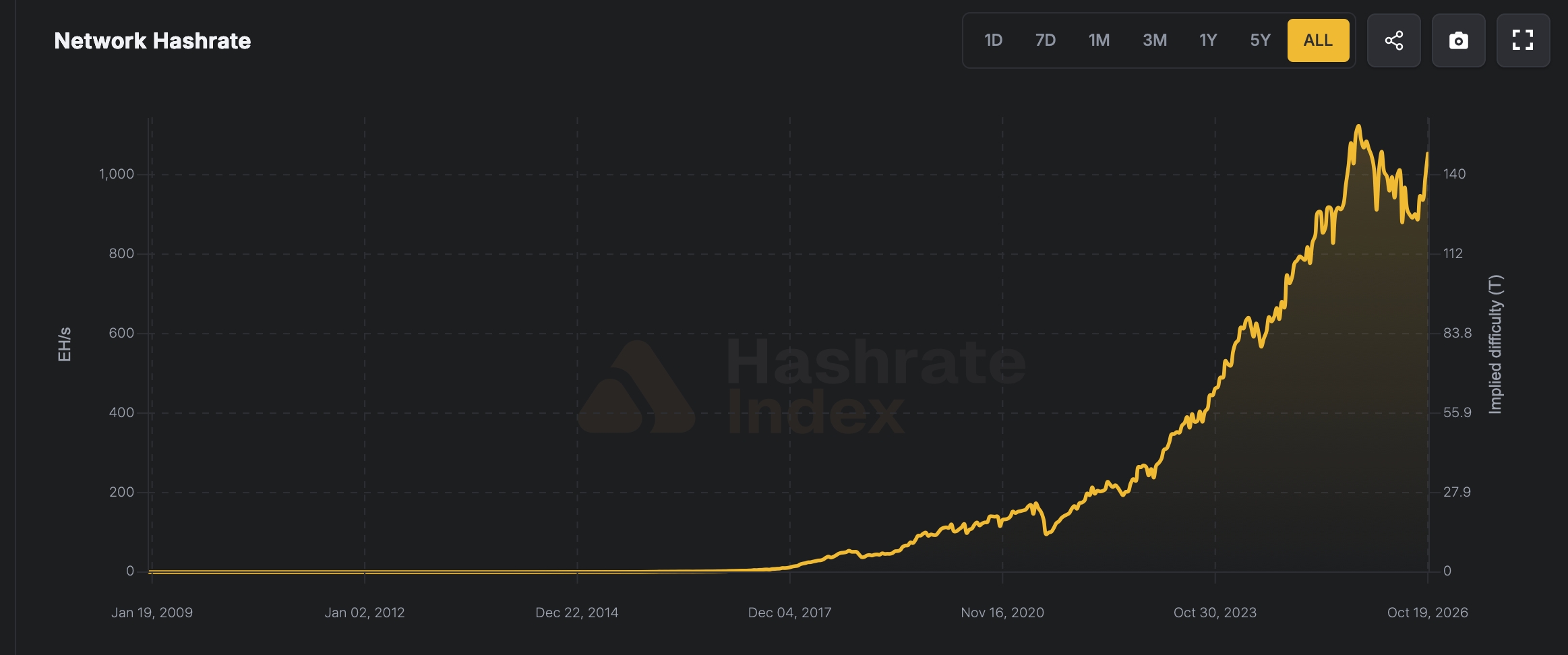
Bitcoin’s seven-day average hashrate has returned above 1 zettahash per second (ZH/s) for the first time since 3 March, almost eight months after it last reached the milestone.
The network is now processing more than 1 sextillion calculations every second as miners compete for newly minted bitcoin and help secure the blockchain.
Bitcoin’s hashrate currently stands at 1,080.23 exahashes per second (EH/s), equivalent to 1.08023 ZH/s. The figure follows the latest mining difficulty adjustment, which took place about nine days ago at block height 971712.
The recovery has come while Bitcoin’s price is hovering near $80,000 per coin. It has also coincided with several large mining companies redirecting equipment and investment towards artificial intelligence (AI) and other high-performance computing projects.
Smaller, solo and privately owned mining operations appear to have helped fill that gap, allowing the network’s total computational power to continue rising despite the wider industry shift.
More efficient mining hardware
Improvements in Bitcoin mining technology over the past two years have produced faster machines that use less energy. That progress has given miners an important advantage as competition intensifies.
The most advanced current mining rigs can complete hundreds of trillions of calculations per second, with some models now exceeding 1 petahash per second (PH/s), or 1,000 terahashes per second (TH/s).
Mining efficiency is assessed in joules per terahash (J/TH), which measures the energy needed to produce a set amount of computational work. A lower number indicates that less electricity is required for the same hashing performance.
Several newer machines made by manufacturers including Bitmain and MicroBT now operate below 10 J/TH, giving them a significant economic advantage over older equipment.
Although the network has crossed 1 ZH/s again, it remains below previous highs of roughly 1.3 to 1.44 ZH/s. It has nevertheless recovered substantially from July’s low of about 726 EH/s.
Pressure on mining profitability
Bitcoin’s market value remains the biggest factor that could restrict further growth in hashrate. Its US dollar price has fallen over the past 30 days, adding pressure to hashprice.
Hashprice represents the market value of a given amount of computing power over a 24-hour period. It is currently $36.04 per PH/s per day, down from $40.42 on 25 September 2026, according to hashrateindex.com.
Mining difficulty increased by a further 5.92% at the most recent adjustment. Even so, blocks were being produced every 9 minutes and 31 seconds on average over the previous 24 hours.
That faster rate suggests the next adjustment, expected on 29 October, is likely to result in another increase. The hashrate rebound indicates that gains in hardware efficiency are currently outweighing the movement of capital and expertise into other sectors.
However, falling hashprice and rising difficulty mean the smaller private miners supporting the recovery may be operating on much tighter profit margins than the headline hashrate figures indicate.


