
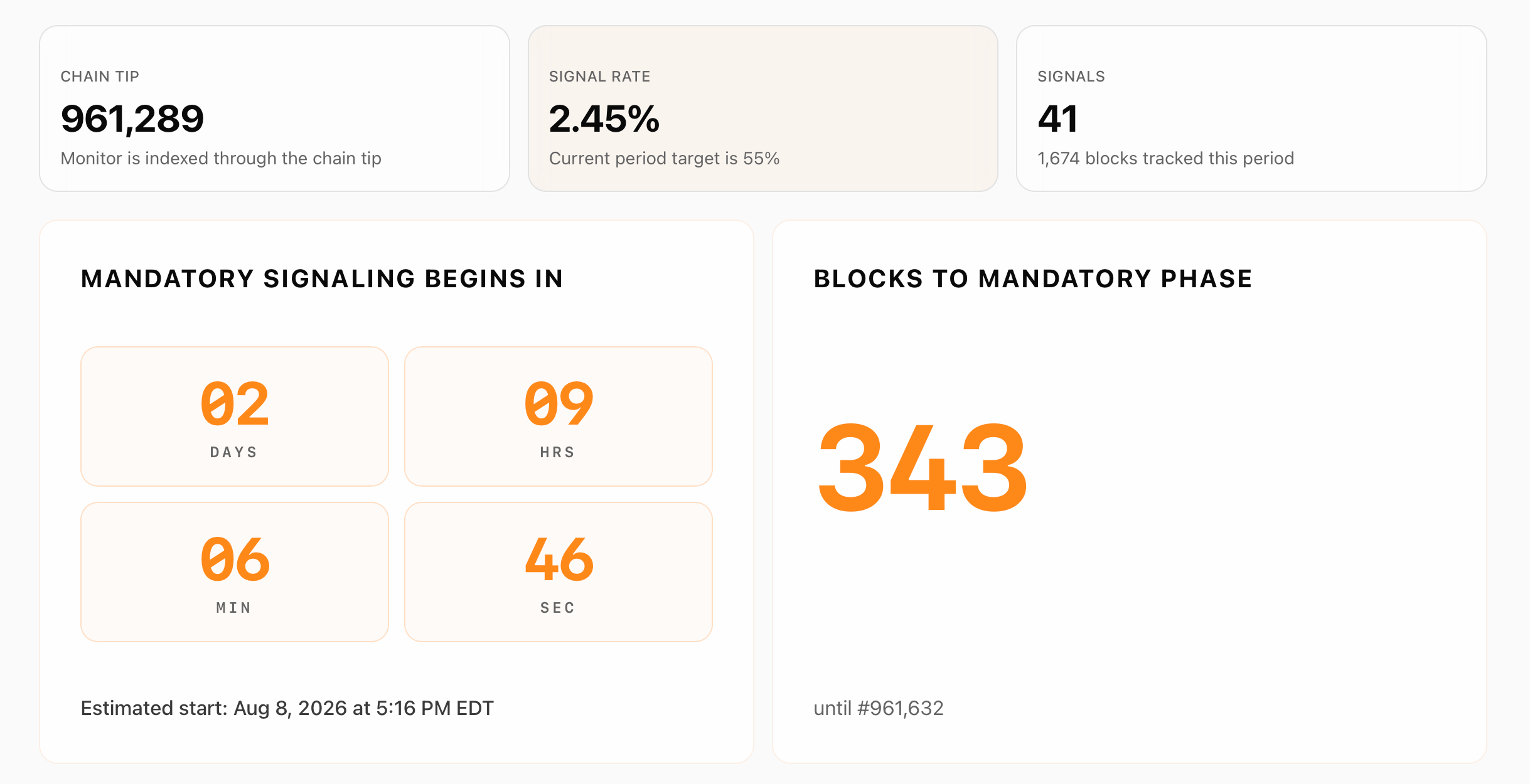
Bitcoin is moving towards a possible chain split after block 961,632, with supporters of BIP-110 preparing to enforce new rules despite receiving backing from only a small fraction of the network’s computing power.
At block 961,289 on Thursday morning, the network was about 343 blocks from the start of BIP-110’s mandatory signalling period. Data from the bip110.org/monitor dashboard showed 41 supporting blocks out of 1,674 counted in the current signalling period, equivalent to 2.45%.
The mandatory phase was expected to begin on 8 August at about 17:16 EDT.
BIP-110, formally known as the Reduced Data Temporary Softfork, would restrict certain forms of data placed inside Bitcoin transactions for around one year. The proposal targets data associated with Ordinals inscriptions and several token protocols.
Its supporters say the measures would slow the growth of Bitcoin’s blockchain, reduce the cost of operating a node and refocus the network on conventional financial transfers.
The change is being distributed largely through Bitcoin Knots, an alternative implementation of Bitcoin node software. Bitcoin Core, which is used across much of the network, has not adopted the proposal.
Normal bitcoin payments and Lightning Network transactions are intended to continue operating under BIP-110. Existing coins would also remain usable, with no requirement for holders to migrate, convert or otherwise handle their funds differently.
The central dispute concerns how the proposal would be activated. BIP-110 requires support from 55% of miners, a significantly lower threshold than the roughly 95% level used for a number of previous Bitcoin upgrades.
Under its rules, nodes enforcing BIP-110 would reject blocks that do not signal support after block 961,632. That would apply even if those blocks represented almost all of Bitcoin’s computing power.
As a result, the proposal could create two competing transaction histories. Most miners and Bitcoin Core users are expected to continue following the existing rules, while BIP-110 nodes could form a smaller chain made only from blocks that signal for the change.
With support currently close to 2.5%, the minority chain could initially produce blocks much more slowly than Bitcoin’s normal rate of about one every 10 minutes. Mining difficulty would eventually adjust, but confirmations could take hours or longer before that happened. The main Bitcoin chain is expected to continue producing blocks without significant disruption.
Mining pools including Foundry, Antpool, F2pool and Viabtc have declined to signal for BIP-110. F2pool co-founder Chun Wang, who frequently uses the handle @satofishi, addressed the issue on X this week.
Limited exchange and infrastructure support
Bitcoin holders could technically receive coins on both chains because the networks would share the same transaction history before any split. That duplication, however, would not guarantee that the new asset had value.
A forked coin would need miners, wallets, developers, exchange listings, custody arrangements and willing buyers to become a functioning market rather than simply a duplicate record of ownership.
Major centralised exchanges have offered little public guidance on BIP-110 and none has committed to listing a separate token. With most economic activity expected to remain on the main Bitcoin chain, exchanges have limited incentive to support an asset associated with a small minority network.
Bitcoin.com News identified a small number of crypto infrastructure providers that had announced contingency plans. The Australian bitcoin-only exchange Hardblock said on X that it was preparing for the possibility of a fork.
Amboss, a provider of Lightning Network tools and analytics, described early August as a period of heightened fork risk. Australian bitcoin exchange Bitaroo also moved to prepare for the event, planning to freeze deposits and withdrawals while mandatory signalling approached and operational uncertainty increased the risk to counterparties.
There has been little public comment from major international exchanges such as Coinbase, Binance and Kraken, major custodians including BitGo, Fireblocks and Anchorage, or other large infrastructure providers.
That response contrasts with 2017, when exchanges commonly published detailed guidance before Bitcoin forks. Platforms suspended deposits and withdrawals, created new trading pairs and explained how customers could claim duplicated coins.
The Bitcoin Cash (BCH) split remains the clearest example. Bitcoin Cash separated from Bitcoin on 1 August 2017 at block 478,558, increased transaction capacity through larger blocks and quickly attracted miners, exchange listings and liquid trading.
Bitcoin Gold followed in October. Other projects, including Bitcoin Diamond, Super Bitcoin and United Bitcoin, emerged during the months that followed, alongside dozens of smaller copycat networks.
More than four dozen projects claimed links to Bitcoin’s transaction history during the fork boom of 2017 and early 2018. Broader databases recorded more than 100 once abandoned launches, airdrops and registration-based schemes were included.
Most disappeared after developers left, miners withdrew or trading dried up. Bitcoin Cash, Bitcoin SV and Bitcoin Gold are among the few that retain a measurable presence.
A different ownership landscape
Bitcoin’s ownership structure has changed considerably since the 2017 fork wave. Retail traders then held more of the available bitcoin, and many were comfortable controlling private keys and claiming assets created by splits.
A significant amount of bitcoin is now held through exchange-traded funds, corporate balance sheets and institutional custody platforms managing large pools of capital.
BlackRock’s spot bitcoin ETF and Strategy’s corporate treasury represent a type of major holder that was largely absent during the earlier fork cycle. Such institutions would not automatically recognise or distribute a minority-chain asset.
Custody agreements, regulatory obligations and security controls could prevent clients or shareholders from receiving forked tokens, even where the underlying private keys technically control balances on both chains.
Strategy founder Michael Saylor has rejected BIP-110 and recently told supporters to “stand down”. Critics, including Saylor, argue that forcing a split without broad miner and economic backing would increase risk without improving the network used by most holders.
Supporters of the proposal say restricting non-financial data is a moral responsibility and that voluntary attempts to prevent what they describe as spam have failed.
The first major checkpoint is block 961,632, when BIP-110 nodes are due to reject blocks that do not signal support. Block 963,648 is the final possible lock-in point under the proposal’s mandatory route, while the full restrictions could take effect at block 965,664 on a chain that successfully achieves lock-in.
For people holding BTC or leaving funds with major exchanges, no action is currently required. Those seeking coins on a minority chain could face replay attacks, unreliable wallets, weak infrastructure and the risk of exposing private keys.
Similar claims during the 2017 fork cycle often produced rewards worth considerably less than the security risks involved in collecting them.
BIP-110 supporters are expected to continue regardless of the low signalling rate. Whether their chain becomes significant will depend on miners, exchanges and major businesses.
Strategy has also reiterated its ambition to become the world’s largest company by market capitalisation, outlining a capital strategy based on bitcoin.
Unless support changes sharply, block 961,632 is more likely to begin a small Bitcoin side experiment than a serious contest for control of the network.


