
Bitcoin could rise to between $250,000 and $840,000 over the next three to five years if investment portfolios increase their exposure to the cryptocurrency, according to a new adoption model from River.
The projection is based on the possibility that traditional asset managers begin allocating a small proportion of their holdings to Bitcoin, bringing investment closer to ranges recommended by major financial institutions.
At present, Bitcoin ownership remains limited. About 4% of the global population is estimated to own the asset, while institutional investment represents only a very small share of the world’s total wealth under management.
Investment advisers currently allocate approximately 0.008% of their assets to Bitcoin on average. River’s analysis suggests that this leaves considerable scope for further adoption if institutional interest continues to grow.
The model assumes that between 20% and 40% of global investment portfolios eventually allocate 2% to 4% of their holdings to Bitcoin. Those figures are broadly in line with recommendations increasingly being made by large financial institutions, where suggested allocations commonly range from 1% to 7%.
Based on an estimated global financial asset base of $333 trillion, the assumptions would generate between $1.3 trillion and $5.3 trillion in potential net inflows into Bitcoin.
That scale of investment could have a substantial effect because Bitcoin’s supply is fixed and cannot expand in response to increased demand in the same way that shares or some commodities can.
Adviser interest in cryptocurrency has already increased. The proportion of financial advisers allocating money to crypto rose from 22% in 2024 to 32% in 2025. A further 56% said they planned to add exposure or were considering doing so.
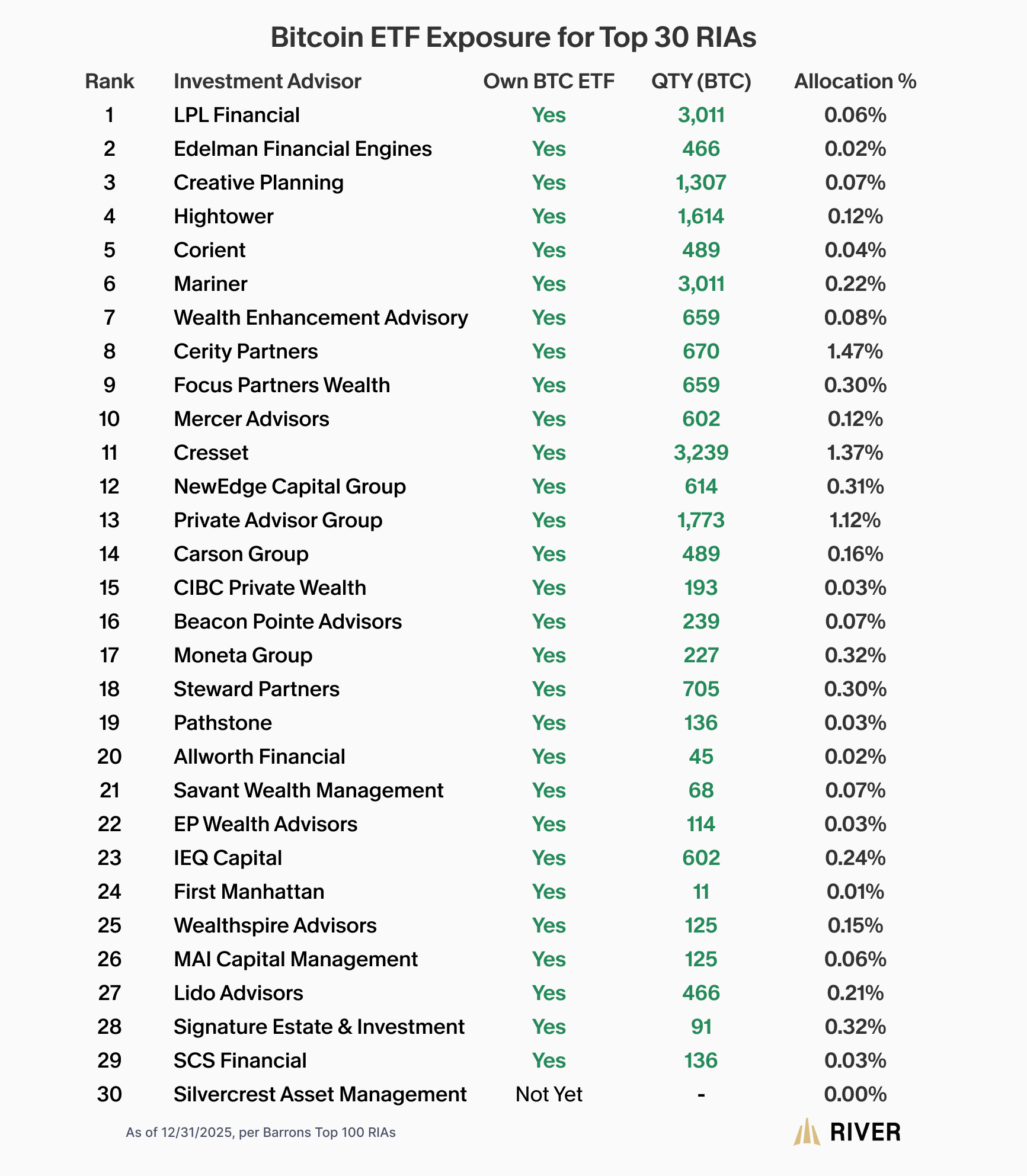
Bitcoin is also being held by 29 of the 30 largest US-registered investment advisers, although the median allocation among them remains only about 0.10%.
River’s model uses an additional assumption about Bitcoin’s response to new capital. It estimates that every dollar flowing into the asset creates approximately $3 in additional market value, based on its historical price performance.
Previous market cycles produced increases in market value of about $4.50, $3.30 and $3.10 for every dollar of net inflows. Applying a more cautious three-times multiplier to the projected investment would produce a Bitcoin market value of roughly $5.5 trillion to $17.5 trillion.
That would equate to a price of approximately $250,000 to $840,000 per Bitcoin.
The forecast is not certain. Adoption may slow, institutional allocations may remain modest, or the historic relationship between new investment and market value may weaken.
However, the report argues that the central trend remains significant: Wall Street is increasingly recommending Bitcoin exposure even though most investment portfolios currently hold very little of the asset.
If only a portion of the potential capital moves into cryptocurrency, the effect on Bitcoin’s price could still be considerable.
Bitcoin’s August short squeeze briefly pushed its price above $80,000, but the rally soon lost momentum below a significant resistance zone.


