
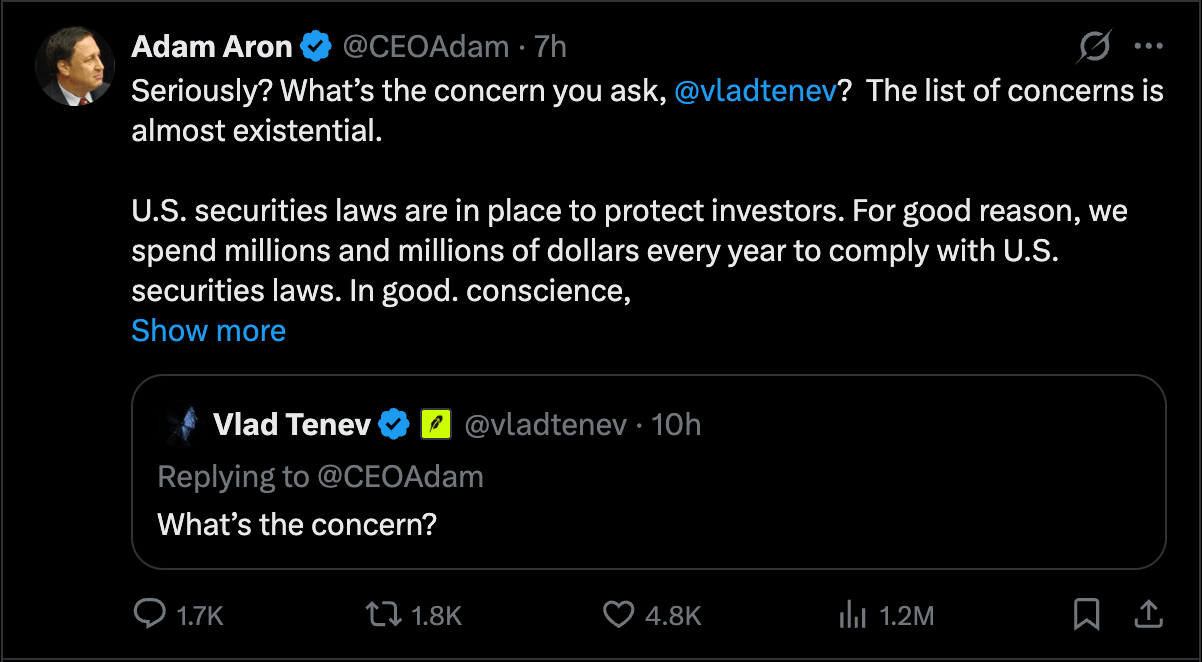
AMC Entertainment chief executive Adam Aron has demanded that Robinhood halt trading in a token linked to AMC shares, prompting an unusually public dispute with Robinhood CEO Vlad Tenev and Chief Legal Officer Dan Gallagher.
Aron said AMC had not authorised or endorsed Robinhood’s AMC-linked Stock Token, which is being traded outside the United States and paired with meme coins on Robinhood Chain. He questioned how a product referencing AMC could be offered without registration under US securities laws.
In a post on X, Aron described the token as “contemptible, outrageous, inexcusable” and called on Robinhood to stop offering it.
“I hereby call on you and Robinhood to voluntarily CEASE the trading of AMC stock tokens,” Aron wrote. He added that AMC had instructed securities lawyers to explore whether the company could compel Robinhood to end trading in the product.
Tenev responded briefly to Aron’s criticism, asking: “What’s the concern?”
Gallagher then warned that Robinhood was confident in its legal position. “We know a little something about the U.S. securities laws. Send your lawyers and we’ll educate them,” he wrote. Tenev later added: “We stand behind Stock Tokens.”
Robinhood, which recently reported record second-quarter earnings, has become embroiled in the dispute as its tokenised products gain attention in cryptocurrency markets. The company’s Stock Tokens are described in its documentation as debt securities issued through a Jersey-based entity. They are designed to track the economic performance of an underlying security but do not provide voting rights, dividend claims or direct ownership of the shares.
Aron argued that such products could reduce companies’ control over capital raising, leave investors uncertain about their rights and further damage confidence in financial markets. His intervention has divided commentators over whether the AMC chief is identifying a genuine securities-law concern or objecting to a financial structure that is separate from traditional share ownership.
One commentator, Dr. Mickey, said Aron had overlooked the offshore structure and Regulation S framework. He noted that the product was not offered to US residents and stressed that AMC had not issued the token.
Donnahue George took the opposing position, supporting Aron’s call for greater scrutiny of stock tokens that do not provide conventional shareholder rights.
Attorney Ariel Givner said the dispute highlighted wider concerns about how tokenised stocks are marketed.
“Most tokenized ‘stocks’ are hopium and hot air,” Givner wrote on X. “They are not the shares. They are not redeemable for the actual equity.”
Givner said buyers of the AMC-linked product did not receive voting rights or a direct claim on AMC. Instead, they obtained economic exposure through an offshore structure using the company’s ticker.
A further technical criticism came from Shanaka Anslem Perera, who noted that AMC had issued 342.7 million shares in the first half of 2026 through capital-raising and debt-related transactions. Perera argued that Robinhood’s product did not create additional AMC shares.
The distinction between direct ownership and synthetic exposure is now central to the dispute. Aron regards the token as a threat to investor rights and corporate control, while supporters of Robinhood’s approach argue that synthetic exposure to shares is not new. The difference, they say, is that Robinhood has made that exposure portable, programmable and tradable around the clock onchain.
The public argument also spilled into meme-coin trading. According to Jussy World, a meme coin with the ticker AMC standing for A Meme Coin was launched on Robinhood Chain in response to the dispute. Its market capitalisation rose to $135m, while trading volume reached $116m.
Robinhood Chain has attracted significant activity, with app revenue at one point exceeding that of Ethereum and Hyperliquid.
AMC shares also rose in pre-market trading after Aron’s posts, climbing to about $3.07 from Thursday’s closing price of $2.54.
The movement underlined the wider challenge facing both traditional financial markets and cryptocurrency platforms: tokenised exposure to share prices can continue trading around the clock, including when equity markets are closed.
For Aron, that continuous trading is at the heart of the problem. For Robinhood, it represents the purpose of the product.
On Wednesday, equity markets rose after the release of the consumer price index report, while GameStop’s stock was also in focus.


