
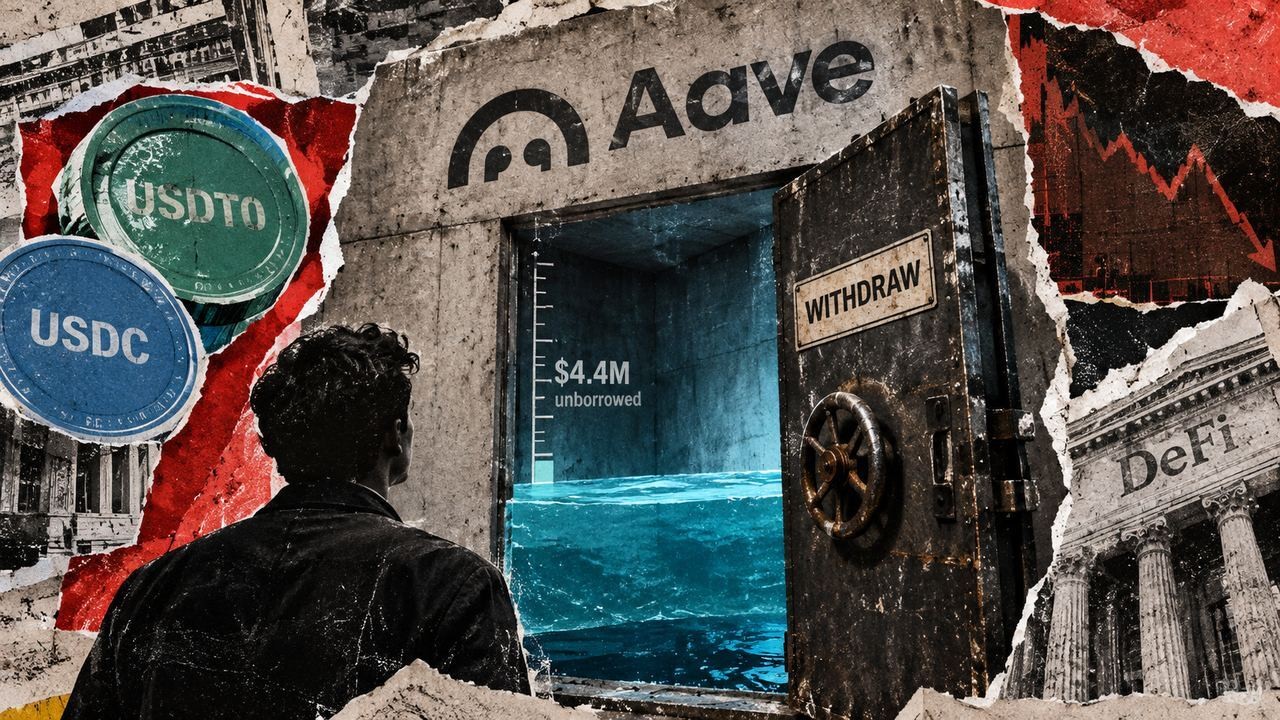
Aave’s USDT0 lending pool on the Monad network offered a displayed annual percentage rate of 6.10% over the weekend, but only about $4.4m of its $55.9m supplied balance was available to withdraw.
Aavescan data recorded $51.5m in outstanding borrowing from the reserve on 12 September 2026 at 21:09 UTC. The figures followed a 11 September analysis by Aave service provider TokenLogic, which reported a sharp earlier fall in USDT0 deposits.
The estimated unborrowed balance represents 7.9% of the pool’s supply. It is calculated from rounded dashboard figures, rather than being an exact transaction quote or cash set aside for a particular account.
Aave suppliers can withdraw only underlying tokens that have not been borrowed. A depositor using the position as collateral may also need to retain enough collateral to support their own loans.
A hypothetical direct withdrawal of $5m would have exceeded the available buffer unless fresh deposits or repayments arrived first. There was no evidence that such a withdrawal was attempted or that a transaction failed.
The corresponding figures for the Aave V3 Monad reserves were:
| Reserve | Supplied | Borrowed | Estimated unborrowed | Total supply APR |
||:|:|:|:|
| USDT0 | $55.9m | $51.5m | $4.4m | 6.10% |
| USDC | $197.3m | $180.0m | $17.3m | 6.10% |
USDC therefore had a larger cash buffer at the same displayed rate, although more than nine-tenths of the supplied funds in both reserves had been lent out. Its supply also exceeded the $163.7m recorded in TokenLogic’s earlier reserve table, which does not support a conclusion that all of Monad’s stablecoin markets were retreating uniformly.
TokenLogic said USDT0 deposits had peaked at $167.3m on 15 August before falling to about $57.2m over roughly three weeks. Debt remained between $53m and $62m. Its hourly review covered 8 August to 7 September: USDT0 spent 261 of 721 hours above the 92% optimal-utilisation threshold, including 13 hours above 98%. The peak hourly borrowing APR was 27.21%, an annualised borrower rate at one point rather than a lender’s realised return.
Aave’s interest-rate model raises borrowing costs as utilisation approaches full capacity. The higher rate is intended to encourage repayments and attract new deposits, either of which can restore withdrawal liquidity. However, the rate can also rise simply because suppliers withdraw funds while existing loans remain outstanding.
Yield and incentives
The 6.10% USDT0 return comprised a 4.34% protocol APR and an estimated 1.76% WMON reward APR. USDC’s total consisted of a 4.07% protocol APR and 2.03% in WMON rewards.
TokenLogic proposed increasing USDT0 and USDC’s Slope1 parameter from 4.40% to 5.00%, while leaving the 92% utilisation point, base rate and second slope unchanged. The recommendation’s execution was unconfirmed at reporting time. TokenLogic’s projected displayed rate of about 6.28% also depended on rebasing incentive campaigns, while the observed 12 September figure was 6.10%.
TokenLogic identified itself as an active Aave DAO service provider. LlamaRisk, which independently prepared the review, said it received part of its funding from the Aave DAO.
TokenLogic’s comparison of Morpho products on 7 September showed 2.62% organic APY and 2.96% incentive APR for the Ethereum PayPal USD Main V2 vault, and 2.53% organic APY with 3.57% incentive APR for Sentora RLUSD Main V2. Those historical figures involved different assets and were not alternatives to the Monad rates.
Coin Metrics reported on 1 September a 4.79% median yield and approximately 5.31% average across Morpho USDC vaults over the previous 90 days. The average was lifted by higher-yield outliers. APR does not include compounding, while APY does, and neither guarantees a depositor’s eventual return.
Morpho’s V2 vaults can direct assets into lending markets and other approved yield sources. Its withdrawal process may first use idle tokens and then draw from a selected market. If idle liquidity is exhausted and that market is fully utilised, a withdrawal can revert. Funds may instead be reallocated, although an in-kind redemption can leave the holder with an illiquid underlying position rather than immediately spendable stablecoins.
For the Aave reserve, deposits, repayments and the unborrowed balance are therefore as important as the headline rate. A higher APR does not by itself show stronger demand or greater access to cash.


