
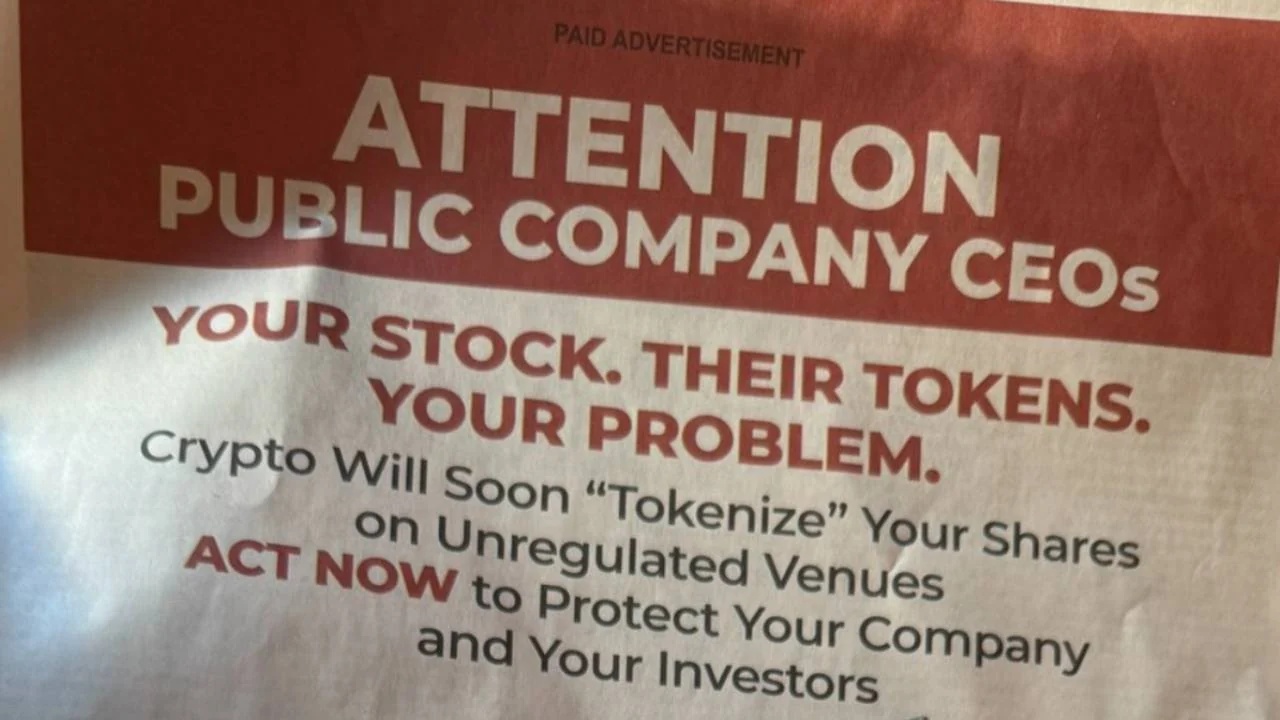
A full-page advertisement warning that tokenization could threaten capital markets has drawn criticism from crypto executives, who say legitimate concerns about the technology have been mixed with a misleading description of how it operates.
The advert appeared in the Wall Street Journal on Sunday, the 24th, and urged chief executives of public companies to reject tokenization. It has since prompted debate on social media over whether putting real-world assets, including stocks, on blockchain networks could undermine market stability.
It was funded by the Common Sense Leadership Fund, a 501(c)(4) non-profit civic organisation founded in 2021 and based in Arlington, Virginia. The group says it is “dedicated to helping promote real, positive, impactful policies that promote individual freedom, lower taxes and less regulation”.
The organisation listed several potential dangers for companies that tokenise their shares. These included apparent differences in prices between token trading venues, difficulty identifying token holders, a reduced ability to raise capital, cyber-security threats, market manipulation, possible AML/KYC loopholes and limited investor protection.
The advert also warned that company chief executives could be held responsible for “anything that goes wrong”.
Carlos Domingo, chief executive of Securitize, a public company that provides tokenization services to traditional businesses, said the advert’s account of the process was “misleading”.
He argued that it “mixes tokenization with how it is done and where those tokens trade”.
“None of those concerns apply to proper tokenization done in the US under SEC regulations and traded on regulated venues,” Domingo said.
He blamed much of the concern on offshore synthetic products. These are derivatives designed to replicate the economic performance of a stock without giving the holder ownership of it.
“I see this as a tailwind for companies like ours doing it the right way, which was never easy, but it’s a durable long-term business model,” Domingo added.
Gabriel Shapiro, co-founder and chief executive of MetaleX, raised a separate concern about how voting power could develop if intermediaries such as Robinhood and Coinbase became larger holders of tokenized shares.
He said those firms could wield significant influence during contested shareholder votes, where a difference of only a few percentage points might determine the result.
“Public companies will care about this more than crypto people expect,” Shapiro said.
The debate comes after several major companies objected to being listed by OKXICE, a joint venture that applied to operate as a Tokenized Security Venue under the Securities and Exchange Commission Innovation Exemption.
The companies named were Microsoft, Alphabet, Goldman Sachs, Qualcomm, Caterpillar, McDonald’s and Western Digital.
Goldman Sachs chief executive David Solomon has said tokenization could reshape financial markets and create new sources of revenue, rather than simply threatening traditional…


