
Bitcoin may produce returns of three to five times its current value during this cycle, while any subsequent decline could be less severe, according to Cryptoquant founder and CEO Ki Young Ju.
Ju said increasing institutional ownership and a larger pool of capital were reducing the extreme price movements seen during earlier Bitcoin booms. In a 22 September cycle forecast on X, he argued that the market’s expansion was limiting both potential gains and losses.
“When Bitcoin was smaller and retail dominated, hot money fueled explosive rallies and 80% crashes. Today, a much larger market and growing institutional ownership are dampening both extremes. The same forces that limit the upside also soften the downside,” he said.
The assessment is consistent with historical research from Fidelity Digital Assets, which reported falling Bitcoin volatility in May 2024. Fidelity said that as a market grows, incoming capital should have a smaller effect on its price. Its analysis showed volatility declining over time, while noting that historical relationships do not prove a specific future price outcome.
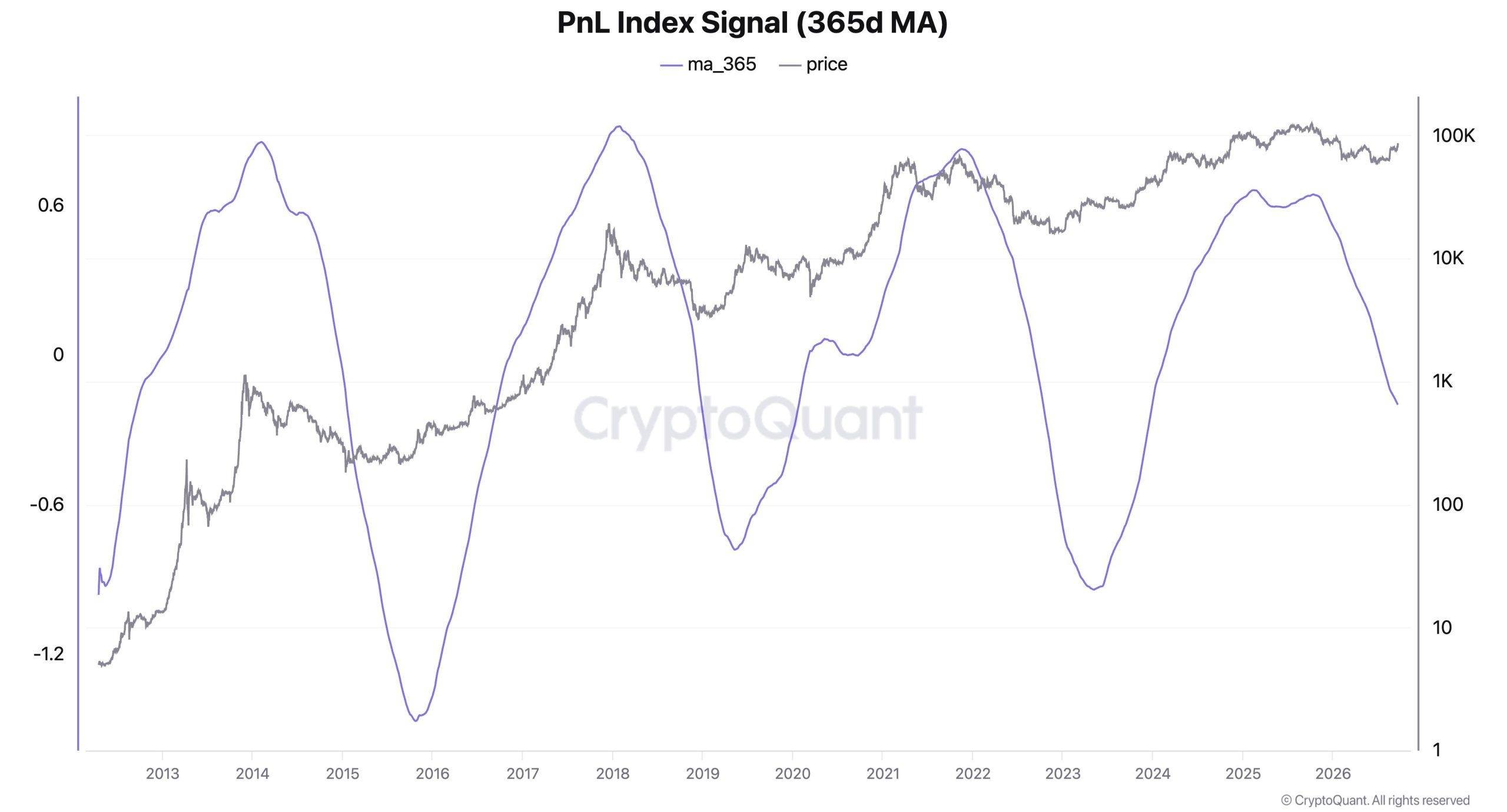
Ju based his view partly on a profitability index measuring the combined gains and losses of Bitcoin holders. He said the measure had recorded less extreme peaks and increasingly resilient lows across successive cycles.
He also pointed to a developing change in the index’s 365-day moving average. The measure smooths short-term movements and generally reacts after broader market conditions have started to shift.
A chart comparing Bitcoin’s price with the index showed recent profitability highs below those reached in previous cycles. That supports the view that market extremes are becoming less pronounced. However, the moving-average line remained below zero and was still falling at the end of the chart.
Ju said Bitcoin had remained above holders’ average onchain cost basis even at the lows of the current cycle. He referred to the market-value-to-realized-value ratio, which compares Bitcoin’s market capitalisation with a valuation based on the last onchain movement of each coin. The ratio remained above one, suggesting that although some investors realised losses, holders collectively stayed above their estimated purchase cost.
Glassnode’s analysis on 8 September offered a different explanation for Bitcoin’s historically low volatility. It identified long-term holder supply as the strongest factor among those examined, accounting for nearly 19% of detrended volatility variance. Market capitalisation accounted for approximately 3%, indicating that the size of the market alone could not fully explain its greater stability.
Ju also cited rising realised capitalisation, an end to selling by long-established large holders and sizeable bullish futures positions as positive indicators. He interpreted higher realised capitalisation as evidence of new money entering the market and said large futures traders had established long positions near the cycle low.
His latest forecast follows an earlier prediction that international institutional demand and access to exchange-traded funds could influence Bitcoin’s eventual peak. In August, Ju highlighted markets where regulated investment access was still restricted, saying wider fund availability, deeper stablecoin liquidity and tokenised-asset infrastructure could encourage participation outside the United States.
Wallet data also showed two smaller-holder groups declining by 69,494 addresses before Bitcoin recovered above $85,000. Santiment linked the fall between July and August to capitulation, while stressing that the figures represented changes in address-balance categories, not necessarily an equivalent number of individual investors leaving Bitcoin.


