
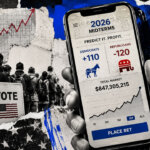
The betting market for the 3 November midterm elections has already attracted far more money than the entire comparable congressional cycle in 2024, but new analysis suggests that most of the displayed odds are being shaped by a very small group of traders.
At least $133m had been placed on markets linked to House and Senate races by 10 August, according to the Anti-Corruption Data Collective (ACDC). That compares with $92.4m across the whole of 2024.
The number of comparable congressional markets has also grown sharply, from 464 in 2024 to 7,466. They include contracts covering primary contests, vote shares, turnout, endorsements, candidate remarks and election winners.
However, on Polymarket Global, the top 1% of wallets accounted for 68% of congressional trading volume. Just 10 wallets generated 17% of activity and traded contracts connected to 426 of the 470 seats being contested.
That concentration raises questions about how the odds should be interpreted as prediction markets become increasingly influential in the way campaigns, donors and media organisations assess elections.
A market can produce an accurate probability even when trading is concentrated among specialists. But a prominently displayed figure may also appear to represent broad public opinion when it has in fact been generated by relatively few participants.
ACDC examined 7,466 markets across Kalshi, Polymarket and Polymarket US using data available up to 10 August. Its comparison with 2024 showed growth across almost every measure.
At the same stage of the 2024 cycle, only 8% of the eventual trading volume had been recorded. If activity accelerates at a similar rate in 2026, ACDC estimates the total could reach $1.6bn. Its lower projection is $1.4bn, with its research dashboard set to update as polling day approaches.
The growth in the number of markets has not been matched by equal depth of participation. Contracts involving the Texas, Maine and Michigan Senate races, as well as Kentucky’s 4th Congressional District, accounted for 67% of state-level volume.
Four out of five congressional markets on Polymarket had fewer than 100 participating wallets. Only 10 had attracted more than 1,000 wallets, a figure broadly comparable with the number of respondents in many political opinion polls.
Across 39,820 Polymarket wallets, 87% of markets either had less than $10,000 in volume or had high volume concentrated among very few traders. In a thin market, a single large order can alter the displayed probability without any underlying change in the race itself.
The expansion from a small number of major contests to thousands of detailed contracts may make that problem more pronounced. A national market on the winner of a presidential election can draw substantial liquidity and frequent arbitrage. A contract concerning a House primary, an endorsement or a phrase in a candidate’s speech may instead depend on a small number of traders whose knowledge and motives are difficult for outsiders to assess.
Polls and prediction markets measure different things. Pollsters sample people, weight the results and publish a margin of error. Prediction markets establish the price at which traders are willing to exchange a contract that pays $1 if a specified event happens.
That price reflects probability, incentives and the capital available in the market. A trader with $100,000 can have more influence than one with $10. Participants can trade repeatedly, hedge positions across several races or provide liquidity without expressing a genuine political belief.
Those features do not automatically make the resulting prices unreliable. Traders with money at stake have an incentive to defend their positions, while an incorrect price can create an opportunity for better-informed participants. A small group of specialists can sometimes outperform a larger but less informed crowd.
The 68% concentration figure alone does not show that the 2026 odds are wrong or manipulated. It does, however, clarify what those odds represent: the clearing price produced by the current participants, within the market’s own limits on liquidity and access. That is not the same as a representative measure of voter intention.
The distinction becomes more important when betting prices spread beyond the trading platform. Television graphics, campaign messages and social media posts can present a contract as a public probability. Donors may use the figures when judging a candidate’s viability, while journalists may treat them as a real-time comparison with polling. Candidates may also cite favourable odds as evidence that their campaign has momentum.
That creates a feedback loop. Traders price political events, media organisations distribute those prices and political figures respond to the coverage. Their responses then provide traders with fresh information.
CryptoSlate has reported that Polymarket and Kalshi are being valued partly as commercial probability feeds with potential media and financial applications. It has also covered proposals to include event-market exposure in brokerage products. Each additional distribution channel can give a market number greater authority, even when the underlying contract is thinly traded.
Enforcement and insider-risk concerns
Election outcomes decided by millions of public ballots generally carry less direct insider risk than events determined within a campaign office. The rapidly expanding range of contracts includes both types.
A February advisory from the Commodity Futures Trading Commission (CFTC) described two cases involving Kalshi. In one, a political candidate traded on his own candidacy. In the other, a YouTube editor traded using advance knowledge of unpublished videos.
The CFTC said its enforcement authority covers the misuse of confidential information, fraud, manipulation and other prohibited practices on designated contract markets.
Kalshi said it had opened 200 investigations during the previous year and had more than a dozen active cases as of February. It froze the two accounts, imposed financial penalties and suspended the traders.
Those measures demonstrate that surveillance systems are operating, but they also underline the scale of the task involved in monitoring thousands of individual contracts.
Polymarket has a different enforcement structure, including pseudonymous wallets on its global platform. Public transaction records can reveal unusual trading performance, but a wallet address alone rarely identifies whether a trader is a campaign employee, pollster or government official. Establishing a person’s identity, responsibilities and access to information requires more than monitoring activity on the blockchain.
ACDC’s earlier study of settled political markets on Polymarket found the strongest warning indicators in outcomes controlled by small groups, particularly military and defence decisions. It defined a longshot as a trade worth at least $2,500 at a price of 35 cents or less.
By that measure, 52% of qualifying military and defence longshots ended with the backed outcome winning, compared with 14% across all categories.
In an extension of that research published on 20 August, ACDC examined 78,496 longshot bets placed by 12,355 wallets. It identified 152 highly specialised wallets active in military markets that had won more than $8m.
Those wallets won at least 75% of their longshot bets under the study’s definition and achieved an average return of 132%. By comparison, high-volume traders lost 2% and semi-automated accounts lost 1%. More than half of the specialised wallets placed their first longshot bet within two days of being created.
The pattern does not establish who made the trades or prove that classified information was used. It does, however, illustrate the difficulty of enforcement. A pseudonymous market can reveal an unusual trade immediately while concealing the trader behind an exchange, a routing wallet or a pooled account.
The same research placed public-outcome markets, including elections, at the lower end of its insider-risk measures. That distinction matters. A market on the winner of a statewide election is different from one asking whether a candidate will withdraw, obtain an endorsement or use a particular phrase in a speech.
The latter events may be decided by a small group of people before the public becomes aware of them.
The CFTC has begun developing rules that address this difference. In remarks on 20 August, chair Michael Selig said the commission expected to propose amendments to Parts 38 and 40 of its regulations. The changes would cover event-contract listing rules, consumer protection, product governance, market design and incentive programmes.
Selig also defended the CFTC’s exclusive federal jurisdiction over designated contract markets and its proposal to define the public-interest criteria applied to contracts involving war, terrorism, assassination, gaming and illegal activity.
New rules could give regulated exchanges clearer responsibilities for contract design and protections for retail users. They would not, however, make a market dominated by 68% of wallets representative of the wider electorate, nor would they reveal the identity behind a global Polymarket wallet.
Platforms will still need to monitor thousands of thin markets and explain why users should trust probabilities heavily influenced by a small number of accounts.
By election day, total trading may reach $1.6bn or fall below ACDC’s projected range. Either outcome will leave the central question unchanged: election betting is now large enough to influence political debate, but its headline dollar figures exaggerate the number of people actually setting the odds.
The 2026 midterms will provide a high-profile test of whether prediction markets can establish authority as a source of political information before their participation levels and oversight systems have caught up.
The article’s contributors include Andjela, who entered the cryptocurrency industry in 2018 after several years covering politics, and Liam Wright, also known as “Akiba”, a reporter, podcast producer and editor-in-chief at CryptoSlate. CryptoSlate says its journalism is human-led, although it may use artificial-intelligence tools in research, editing and production.
The publication states that its writers’ opinions are their own, that its content is not investment advice and that it does not endorse projects mentioned or linked in its articles. It also warns that buying and trading cryptocurrencies are high-risk activities and accepts no responsibility for trading losses.


