
U.S. Senator Cynthia Lummis has renewed her campaign to pass the CLARITY Act, warning that the United States still lacks a comprehensive framework for digital-asset markets after Senate leaders delayed a vote until September.
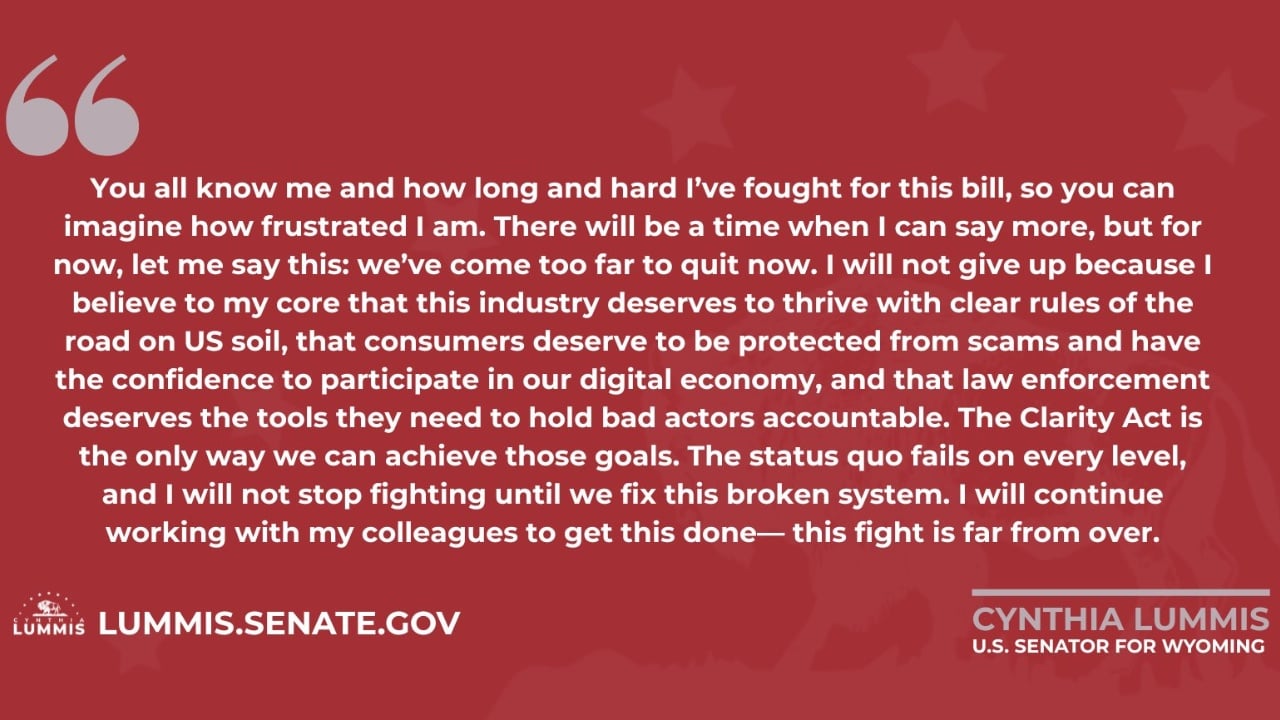
The Wyoming Republican said on X on 7 August that she remained determined to advance the legislation, despite her frustration at the latest delay. She argued that lawmakers had invested too much time in developing a federal crypto framework to abandon the effort now and pledged to continue working with colleagues to secure progress.
The CLARITY Act is intended to establish rules for digital-asset markets, strengthen protections for customers and provide federal authorities with clearer powers to enforce the law.
Lummis, who chairs the Senate Banking Subcommittee on Digital Assets, has become one of the most prominent Senate supporters of the bill. She has played a central role in negotiations and has repeatedly called for the legislation to be brought before the chamber for a vote.
Only two days before her latest statement, Lummis had expected senators to remain in Washington over the weekend in an attempt to secure a vote before the August recess. She referred to 11 months of negotiations, during which more than 300 pages of changes requested by Democrats had been incorporated into the discussions.
Talks were still continuing over provisions involving the Commodity Futures Trading Commission, law-enforcement powers and ethics rules for senior federal officials.
However, Senate Majority Leader John Thune (R-SD) confirmed on 7 August that the vote would not take place before the recess. The Senate will instead consider the legislation when it returns in September.
Consumer protection and business certainty
Lummis has presented customer protection and support for the US digital-asset industry as linked objectives. She says Americans need stronger safeguards against scams and greater confidence when using digital financial services, while legitimate companies require predictable federal rules if they are to operate and expand domestically.
One of the bill’s main financial protections concerns the ownership of customer assets if an exchange fails. Under the proposed legislation, covered customer cash and cryptocurrency would remain customer property, would have to be kept separate from a company’s own assets and would be subject to rules intended to resolve ownership disputes.
The issue was highlighted by the collapse of Celsius. When the company entered bankruptcy proceedings, about 600,000 Earn accounts held approximately $4.2bn.
The CLARITY Act has already secured significant bipartisan support during months of negotiations over the structure of federal digital-asset markets. The Senate Banking Committee approved H.R. 3633, the Digital Asset Market Clarity Act of 2025, by 15 votes to nine on 14 May, allowing the proposal to move beyond the committee stage.
More than a year after the House of Representatives approved the legislation, Senate action remains decisive to its prospects of becoming law. The unresolved framework covers the classification of digital assets, registration obligations, federal oversight and the conditions under which exchanges, developers, asset managers and financial institutions can operate.
Lummis has previously warned that failure to complete the bill during the current opportunity could lead to a much longer wait. She has said the next realistic chance for congressional action could be pushed towards 2030, leaving consumers, developers, exchanges and enforcement agencies under the existing federal system for years.
Despite the latest delay, work on the legislation continued shortly beforehand. On 22 July, Lummis released revised CLARITY Act text combining work carried out by the Senate Banking and Agriculture committees. The updated proposal brought separate parts of the Senate’s digital-asset market-structure work together in a single text.
A new minority staff analysis from the Senate Banking Committee has also revived Democratic concerns that the CLARITY Act preserves possible pathways for President Donald…
With the revised text published and committee consideration complete, attention now turns to September. Lummis and other senators must try to convert months of negotiations into sufficient support for a vote when the Senate returns from its August recess.


