
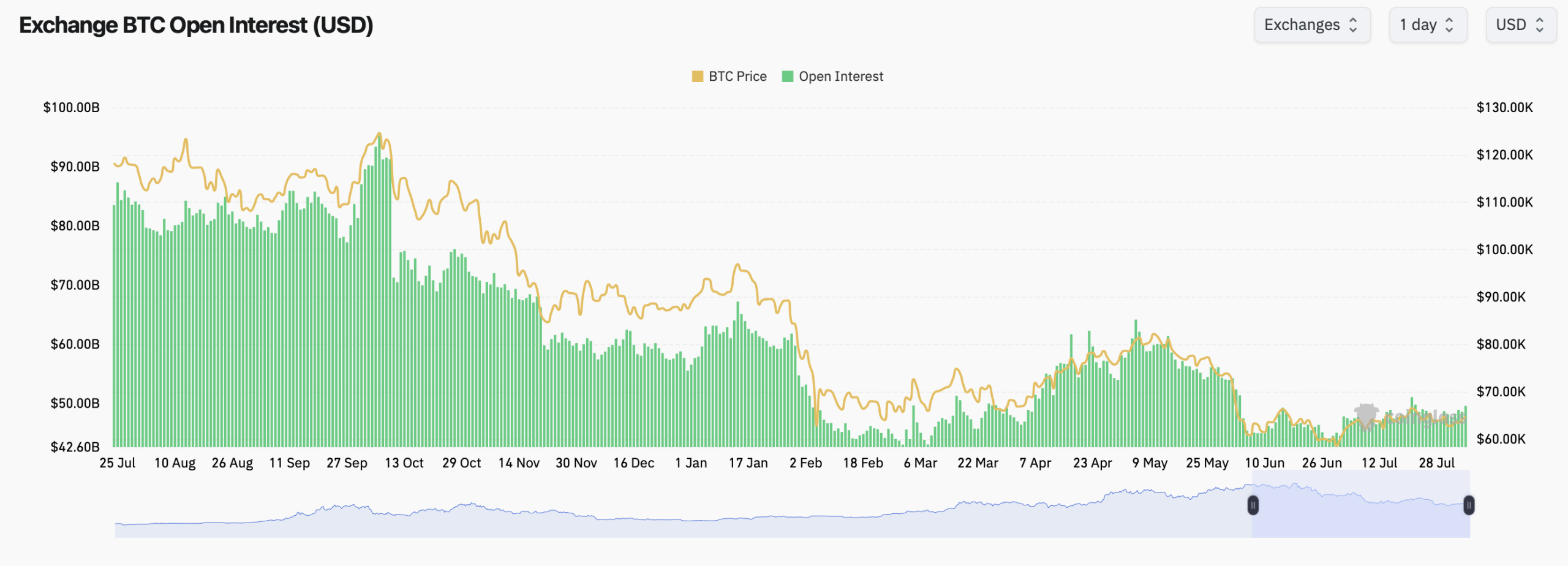
Bitcoin futures traders have built more than $41bn in outstanding positions, while options markets are signalling potential prices well above the current spot level of $64,711.
Binance has the largest share of bitcoin futures open interest, with 148,500 BTC in contracts worth $9.61bn, according to Coinglass.com data recorded on Wednesday. CME is second with 102,840 BTC, valued at $6.66bn, after its open interest rose by 6.82% in a single day.
MEXC has $6.12bn in outstanding futures contracts, while Bybit and Gate each account for roughly $4.5bn.
The rise at CME is particularly significant because it operates on a regulated US exchange and is regarded as the main destination for institutional investors. Its daily increase was larger than that of almost all major competitors, suggesting that larger trading desks may be rebuilding their exposure to bitcoin.
That renewed activity comes after total futures open interest across exchanges fell sharply from about $90bn in September and October 2025, when bitcoin was trading above $120,000, to approximately $43bn in June.
The three-month annualised futures basis – the premium at which contracts trade above the spot price – has also recovered. Newhedge.io, a bitcoin intelligence firm, puts the current basis at about 4.3% across Binance, Deribit and OKX, compared with around 0.3% in late April.
A higher basis often indicates that traders are willing to pay more for future exposure and can therefore reflect improving market confidence. However, the current level remains well below the double-digit premiums associated with overheated bull markets.
Options remain tilted towards further gains
In the bitcoin options market, call contracts – which benefit from a rise in the price – account for 254,394 BTC of open interest. Put contracts account for 156,227 BTC, giving calls a 62-38 advantage over puts.
New activity is more evenly balanced. Call and put volumes over the past 24 hours were almost identical, indicating that fresh investment is less decisive even though existing positions continue to favour a higher bitcoin price.
Total bitcoin options open interest across exchanges has recovered to almost $36bn. CME, however, is showing a different trend. Its options notional value has dropped from about $290m last November to roughly $50m, and puts have consistently outnumbered calls.
Most CME positions are concentrated in expiries one to two months away. That suggests traders are continuing to extend short-term positions rather than committing capital further into the future.
The options market’s so-called max pain level – the price at which the largest amount of options would expire worthless – is also above bitcoin’s current value. The level can attract prices as expiry approaches because option writers stand to gain the most if contracts finish there.
Data from OKX currently places September and December max pain at about $69,000. Binance’s estimate is higher, approaching $80,000 for the 25 December expiry.
Deribit has peaks near $69,700 for September and December before its projected level falls towards $60,000 by the middle of 2027. Every major options venue is therefore indicating a price above bitcoin’s current $64,711 level.
Leverage continues to create sharp losses
Liquidations take place when leveraged positions are forcibly closed because losses have exceeded the collateral supporting them.
Newhedge.io data shows Binance long positions suffered the heaviest losses over the past month. About $70m was wiped out on 6 July, followed by a further $65m on 14 July.
Short sellers were also caught out, with between $30m and $40m of positions erased on 9 and 10 July. By 1 August, another $50m in long positions had disappeared.
The losses underline the risks of excessive leverage, which can be eliminated quickly during volatile market moves regardless of whether bitcoin is rising or falling.
Bitcoin remained above $64,000 despite moving between $63,900 and $64,706 during the day. The next weekly and monthly CME expiries should show whether the options market’s max pain levels continue to rise and whether the futures basis remains above 4% or falls again.
Those indicators will help determine whether bullish positioning is gathering genuine momentum or instead leaving the market vulnerable to another wave of liquidations.


