
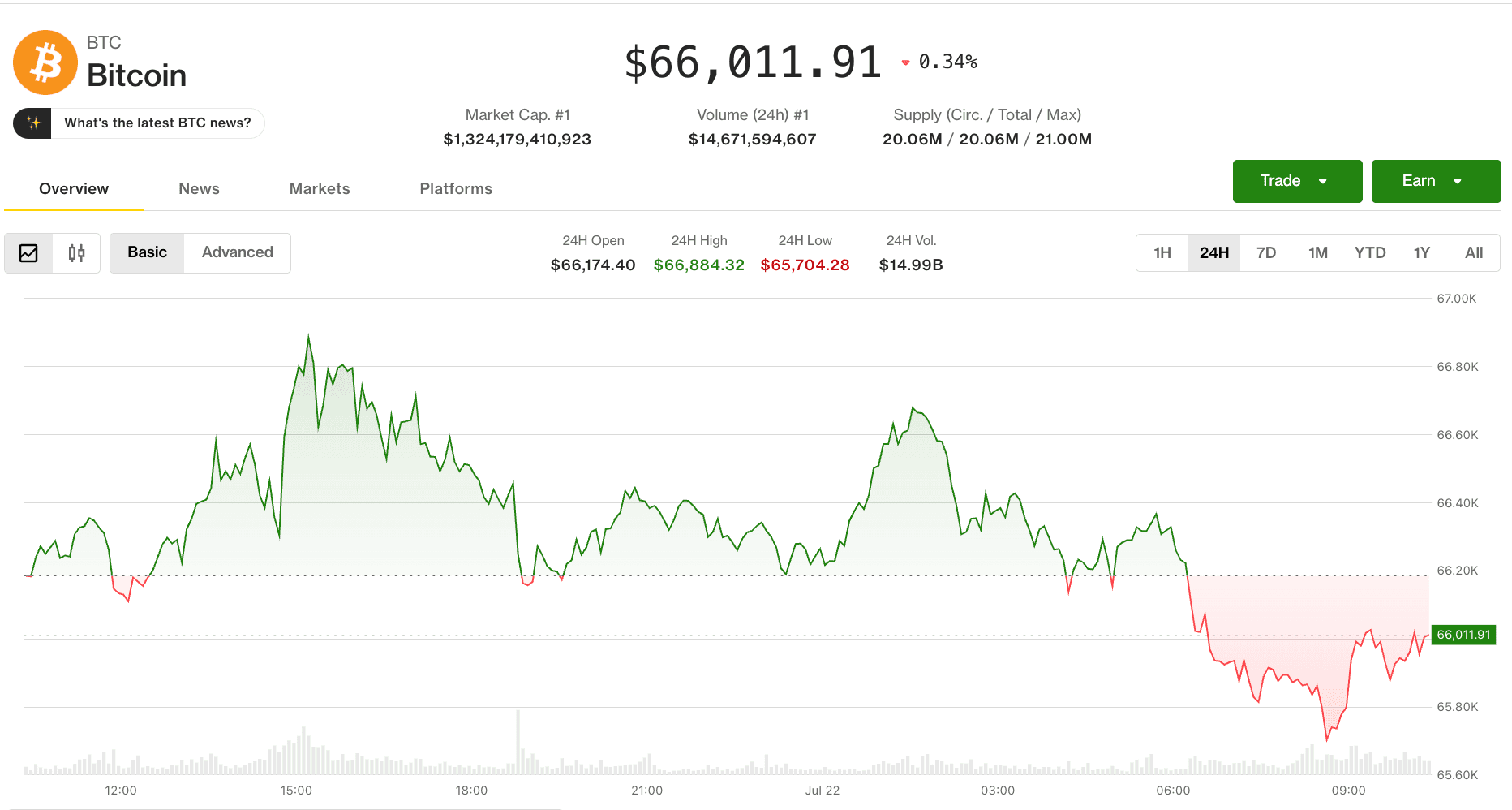
Bitcoin has slipped back below $66,000 after briefly touching its highest level in more than a month, as a sharp rise in oil prices once again stoked worries about inflation and rattled global markets.
The world’s largest cryptocurrency retreated as US benchmark crude, West Texas Intermediate (WTI), climbed above $85 a barrel for the first time since June, reviving concerns that higher energy costs could feed through into broader price pressures.
The renewed inflation anxiety drove investors to traditional havens such as gold and silver, while within the digital asset sector traders also shifted towards perceived safety – favouring bitcoin over smaller alternative tokens.
Analysts said the moves underscored how closely crypto markets are now tracking macroeconomic signals, with risk appetite ebbing as traders reassess the outlook for interest rates and growth.
Risk-off mood boosts bitcoin’s market dominance
While bitcoin’s price eased, its share of the overall cryptocurrency market strengthened, reflecting a broad rotation away from riskier coins and stablecoins.
Bitcoin’s dominance climbed to around 59%, indicating that capital was being pulled from altcoins and parked in the sector’s most established asset as investors adopted a more defensive stance.
This “risk-off” behaviour mirrored trends in traditional finance, where rising energy prices and persistent inflation concerns typically push investors towards safer assets and away from high-growth or speculative bets.
Stablecoins – digital tokens designed to maintain a fixed value, often pegged to the US dollar – also saw outflows, suggesting that some traders were opting to sit on the sidelines or move into hard commodities such as gold and silver instead.
Select altcoins buck the trend despite caution
Despite the cautious backdrop, a handful of smaller crypto projects managed to post gains.
Midnight (NIGHT), a privacy-focused blockchain project, jumped 19% after Cardano founder Charles Hoskinson praised the initiative on social media platform X. His comments appeared to spark renewed interest and trading activity around the token.
Other niche projects linked to tokenised real-world assets – including ether.fi, ethena and ondo – also extended recent rallies. Tokenisation, which involves putting traditional assets such as bonds, property or commodities onto blockchain networks, has drawn growing attention from institutions looking for new ways to trade and settle securities.
Their resilience highlighted a split within the market: while the broader environment is risk-averse, certain themes such as real-world asset tokenisation are still managing to attract capital and speculative interest.
TRON extends grip on stablecoin market
Away from price moves in bitcoin, fresh data from the second quarter pointed to the increasing influence of the TRON blockchain in the stablecoin ecosystem.
TRON’s share of the global stablecoin market rose to 28.7%, consolidating its position as one of the leading networks for issuing and transferring dollar-pegged tokens.
The supply of Tether (USDT) on TRON hit an all-time high of $89bn, underscoring the platform’s importance as a low-cost, high-volume rail for stablecoin transactions, particularly in emerging markets and for cross-border payments.
Protocol fee revenue on TRON reached $89m over the quarter, placing it second only to derivatives platform Hyperliquid, while its native token TRX recorded a 3% gain.
The figures suggest growing institutional and “agentic” reach – industry shorthand for automated, programmatic use of the network – as more firms and applications plug into TRON’s infrastructure.
Inflation outlook keeps crypto tied to macro signals
The latest moves underline how sensitive digital assets remain to shifts in the global economic narrative.
With oil back above $85 and inflation concerns resurfacing, traders are re-evaluating how long interest rates in major economies might stay elevated – a key factor for risk assets from equities to cryptocurrencies.
For now, bitcoin appears to be benefitting, relatively, from its status as the sector’s benchmark asset, even as its price retreats from recent highs. Altcoins and stablecoins, by contrast, are bearing the brunt of the latest bout of risk aversion, reinforcing a familiar pattern when macroeconomic jitters return.


